Monday, 6 January 2014

Alternative Lyrics to Well Known Songs 15 - My Name is Magnus

[Pre-amble: This is one in a series of posts which includes an alternative set of lyrics to a well known song. Each post will also contain a short introduction to the topic at hand, and a brief explanation of the song itself. A video of the original song will be included so that the reader can listen to the original song while reciting the alternative lyrics at the same time.]


The Song: My Name is Mangus (based on 'My Name is Jonas' by Weezer)
This song is told from the perspective of two people who sail on the ship known as 'Will' (as in the word 'Will', as in "I Will do this!"): Magnus, who pilots the ship; and Wake-ful, who is in the wake of the ship after jumping overboard.
 
In the song, Magnus speaks first, addressing the listener on how to get aboard the ship 'Will' and how joyful the life is.  After which Wake-ful then speaks, telling us why he decided to abandon the Will and remain in it's wake.  After a while Wake-ful begins to regret his decision to jump ship and starts mourning his choice.  In his sorry state, alone, no future, no possibilities, and no motivation, Wake-ful cries out for help.  Just as Wake-ful cries out for help the Will, piloted by Magnus, arrives and fishes him out of the water.  Magnus didn't want to leave anyone behind in the ships wake leaving an awful life, so he plotted a circular course making sure that the ship would turn up again at the exact spot that Wake-ful jumped overboard.  That's what the last line in the song indicates: that Magnus has returned to rescue Wake-ful.
 
The moral of the song is that there's always a chance of redemption so long as humility is present.  Without humility, genuinely admitting that we've fouled up, there is no chance that we can learn from our mistakes and get back on the proverbial 'straight and narrow'.  That's something we can all benefit from - knowing when to admit that we're in the wrong and then Righting ourselves.  Once we've done that, then we can get back on board the 'Will' and do our thing, whatever that may be.
 

Play the song in the music video above and sing along with the alternative lyrics given below.


# My Name is Magnus #
"My name is Magnus.
"I pilot the Will.
"Come and jump aboard it,
"and see how we live.
 
"Come sit next to me,
"I will speak with you,
"of the life of the joy and the passion.
"It will rouse you,
"and en-grippen you,
"And take you to places you could never dream of.
 
The Willful ship left right on time.
The ticket is bought by your mind
The pilot said "hey man we go all the way.
"The joy of it shall blow your mind."
 
"My name is Wake-ful.
"I live a sick morbid life.
"I live in the wake made,
"by the ship known as Will,
"Known as Will.
 
"It makes me so sad,
"and yet also mad,
"knowing that I am left,
"deep deep in it's wake.
"Never knowing what;
"Never feeling what;
"The love and the joy of being in Will.
 
"I left the ship free of my choice.
"I tired of living the life,
"of enthusiasm and earnestness,
"And was desperately in need of rest.
 
"But here I am far behind.
"But here I am far behind,
"Will!
 
"But here I am far behind.
 
"Help!
"Help!
"Help!
 
"My name is Magnus."
 
 
[End of lyrics.]

Sunday, 5 January 2014

Havamal Snippets 116: Plan for your journeys into the future

Be prepared for any journeys you make.  This means thinking ahead and foreseeing any circumstances you may encounter.  Whether this journey is a simple and short one over a few steps, yards & minutes (like a drive into the mountains), or a complex and long one over many steps, miles & years (like starting up a business), the ability to plan ahead 'to see into the future' is one that is really good to have.  Thinking ahead requires a man to get his mind out of day-to-day matters and into long term ones.  It's also a good stepping stone which allows a man to move from thinking about physical things to spiritual things, because it moves his attention away from the immediate to the distant.
 
116
Ráðumk þér Loddfáfnir
en þú ráð nemir
njóta mundu ef þú nemr
þér munu góð ef þú getr
á fjalli eða firði
ef þik fara tíðir
fásktu at virði vel               
 
I advise you, Loddfafnir,
to take advice;
you would benefit, it you took it,
good will come to you, if you accept it:
[6] if you long to travel
[5] over mountain or fjord,
be sure you have ample food.

[End.]

Friday, 3 January 2014

Men of Yore: Ignaz Semmelweiss

This is another in a series of posts about men from history who have either achieved great things in one form or another by pushing boundaries: either in themselves or in society or science or exploration of some form. Boundary pushing and growth is what men do, it's their nature: to grow and push outwards. We, as men, are the frontiers men, the first to discover/uncover new territory, in a metaphysical sense (i.e. including both material and the immaterial) that is later colonised and 'civilised' by the rest of humanity. 


Ignaz Semmelweis


Ignaz Philipp Semmelweis (July 1, 1818 – August 13, 1865), also Ignác Semmelweis (born Semmelweis Ignác Fülöp), was a Hungarian physician called the “saviour of mothers” who discovered, by 1847, that the incidence of puerperal fever, also known as childbed fever could be drastically cut by use of hand washing standards in obstetrical clinics.
While employed as assistant to the professor of the maternity clinic at the Vienna General Hospital in Austria in 1847, Semmelweis introduced hand washing with chlorinated lime solutions for interns who had performed autopsies. This immediately reduced the incidence of fatal puerperal fever from about 10 percent (range 5–30 percent) to about 1–2 percent. At the time, diseases were attributed to many different and unrelated causes. Each case was considered unique, just like a human person is unique.
Semmelweis’ hypothesis, that there was only one cause, that all that mattered was cleanliness, was extreme at the time, and was largely ignored, rejected or ridiculed. He was dismissed from the hospital and harassed by the medical community in Vienna, which eventually forced him to move to Budapest.
Semmelweis was outraged by the indifference of the medical profession and began writing open and increasingly angry letters to prominent European obstetricians, at times denouncing them as irresponsible murderers. His contemporaries, including his wife, believed he was losing his mind and he was in 1865 committed to an asylum (mental institution). Semmelweis died there only 14 days later, possibly after being severely beaten by guards. 
Semmelweis’ practice only earned widespread acceptance years after his death, when Louis Pasteur developed the germ theory of disease which offered a theoretical explanation for Semmelweis’ findings. Semmelweis is considered a pioneer of antiseptic procedures. 
Source: http://semmelweis.org/about/dr-semmelweis-biography/


The case of Ignaz Semmelweiss demonstrates a couple of things about 'experts': that they are not infallible; that they will attack anyone who doubts their theories, going so far as to label them insane if needs be; they consider their theories more important than the people they are supposed to (and claim to be) looking after.  Modern day experts are no different to those of 150 years ago, or of any era.  If someone has a PhD, M.D., Dr, Prof, Priest, Imman, Lord, King, President or some other letters or title around their name then that's no reason to consider them infallible.  It's also worth considering that those letters or title were given to them by a group, a culture, that has a particular set of values that might not be in accord with your own values.


[End.]

Wednesday, 1 January 2014

Havamal Snippets 115: never seduce another mans wife

This verse advises against extramarital affairs with other men's wives.  It shows that monogamy is the way of the Viking, or at least the way of living that they aspired towards (after all, they were only human, and may have suffered temptation as we do in modern times). 

The benefits of not interfering with another man's wife is similar to not interfering with another mans property: it promotes mutual feelings of trust amongst the two men, and then amongst the community as a whole.  In turn this allows men to feel safe in their surroundings and thus provides them with a good environment in which to express themselves, to express their own character, to express their own Will.  A society in which men exploit one another and cheat one another is not conducive to this, and thus is not pleasant.  Thus respecting other men's property (inlcuding his wife) is the way to go.


115
Ráðumk þér Loddfáfnir
en þú ráð nemir
njóta mundu ef þú nemr
þér munu góð ef þú getr
annars konu
teygðu þér aldregi
eyrarúnu at          
 
I advise you, Loddfafnir,
to take advice;
you would benefit, it you took it,
good will come to you, if you accept it:
[6] never seduce
[5] another's wife
to be your mistress.
 
[End.]

Monday, 30 December 2013

Alternative Lyrics to Well Known Songs 14 - The Scythian

[Pre-amble: This is one in a series of posts which includes an alternative set of lyrics to a well known song.  Each post will also contain a short introduction to the topic at hand, and a brief explanation of the song itself.  A video of the original song will be included so that the reader can listen to the original song while reciting the alternative lyrics at the same time.]


The Song: The Scythian (based on 'Fear of the Dark' by Iron Maiden)
The Scythians were the fore-runners of the Russian peoples, who lived on the Russian Steppe a few thousand years ago.  This is a song about them.


A reconstructed face of a Scythian noblemman buried in the Nikopol kurhan.
Source: http://www.encyclopediaofukraine.com/display.asp?linkpath=pages%5CS%5CC%5CScythians.htm

 
Play the song in the video above and sing along with the alternative lyrics given below.


# The Scythian #
I ride out there across my Steppe
roaming where ever I please.
And as I stroll across the land,
I meet all kinds of men,
and have plenty of adventures,
sometimes good and sometimes bad.
 
I'm Scythian.
We're Scythians.
We are constantly adventuring 'cross our land.
I'm Scythian.
We're Scythians.
We live a perilous yet death-defying life.
 
Hark!  We have lived in midst of drought,
over three millenia ago.
And yet here we still are!
We have faced off thousands of Cumans,
and the Hellish Mongol Hordes.
And yet here we still are!
 
I'm Scythian.
We're Scythians.
We are constantly adventuring 'cross our land.
I'm Scythian.
We're Scythians.
We live a perilous yet death-defying life.
 
We were the first ones into space,
With the famous Gagarin.
Adventurous we are!
We were the first ones to get rid of
the Judeo-Marxists.
Adventurous we are!
 
I'm Scythian.
We're Scythians.
We are constantly adventuring 'cross our land.
I'm Scythian.
We're Scythians.
We live a perilous yet death-defying life.
 
That's right!
 
I'm Scythian.
We're Scythians.
I'm Scythian.
We're Scythians.
 
I'm Scythian.
We're Scythians.
I'm Scythian.
We're Scythians.
 
Watch as all the world stands in awe,
at our ability to endure,
Forces that would crush them.
Yes here we are once again,
forefront of exploration,
pushing for bases on Mars!
 
I'm Scythian.
We're Scythians.
We are constantly adventuring 'cross our land.
I'm Scythian.
We're Scythians.
We live a perilous yet death-defying life.
 
I'm Scythian.
We're Scythians.
We are constantly adventuring 'cross our land.
I'm Scythian.
We're Scythians.
We live a perilous yet death-defying life.

If you're wondering who looks out
for our fates,
Odin does.

 
[End of lyrics.]


Sunday, 29 December 2013

Havamal Snippers 114: Do not consort with silver-tongued women, they will cause you to turn your back on the world

This continues from stanza 113, which is warning about the perils of sleeping with women skilled in magic, ie psychological tricks..

This verse highlights the dangers of consorting with manipulative women: they will isolate you from the community, from your friends, even from that which formerly gave you pleasure.  (BTW, the 'Thing' is the equivalent of a council or parliament, where men go to speak and decide how the community as a whole is going to act on certain matters.)
 
114
Hon svá gørir
at þú gáir eigi
þings né þjóðans máls
mat þú villat
né mannskis gaman
ferr þú sorgafullr at sofa
       
-- she will make sure
that you do not heed
the speech of either Thing or king;
you will not desire food
or mankind's pleasure;
you will go sorrowfully to sleep.

[End.]

Friday, 27 December 2013

Men of Yore: John Rae

This is another in a series of posts about men from history who have either achieved great things in one form or another by pushing boundaries: either in themselves or in society or science or exploration of some form. Boundary pushing and growth is what men do, it's their nature: to grow and push outwards. We, as men, are the frontiers men, the first to discover/uncover new territory, in a metaphysical sense (i.e. including both material and the immaterial) that is later colonised and 'civilised' by the rest of humanity. 


John Rae


Rae was born near Stromness, on Orkney Mainland. He studied medicine at Edinburgh and in 1833 became a surgeon for the Hudson's Bay Company. This was the start of Rae's association with the Arctic. It quickly became apparent to his employers that Rae's skills as an outdoorsman and his undoubted ability with bots made him more valuable as a surveyor and explorer than a simple medical doctor.In 1846 he made the first of his journeys to the Canadian Arctic, and two years later he was a member of the futile search led by Sir John Richardson to look for the lost Franklin expedition. In 1850 he led a similar expedition, and found two pieces of wood presumed to belong to Franklin's ships. In a subsequent published account of his trip, Rae claims that the flooded landscape made further search at that time impossible.  
He returned to the Canadian north in 1853 to survery the geography of Repulse Bay. There he found the first hard evidence of Franklin's expedition. and purchased from local Inuit articles belonging to Franklin. For this discovery he received a prize of £10,000 from the British government. Rae also reported tales told to him by the Inuit that explained the demise of Franklin and his men. These tales suggested that the lost party had been driven mad by malnutrition and resorted to cannibalism to stave off starvation. Rae's stories were derided iin the public press - perhaps under the considerable influence of Franklin's widow - and Rae was ridiculed and called a liar. Despite the fact that later discoveries back up Rae's tales of Franklin, the Orcadian's reputation never recovered.  
Rae made further journeys through the Canadian north and west, and in 1864 he surveyed the route for a telegraph line through the Rockies from Winnipeg. Over the course of his travels this vigorous man is estimated to have walked over 25,000 miles through the Canadian wilderness. In 1852 he received the prestigious founder's gold ,medal from the Royal Geographical Society. 
In the climate of his day - and given the Victorian passion for creating heroes of their explorers - it may be surprising that Rae's travels did not earn him the fame and public adulation enjoyed by his contemporaries. We mentioned the bad press he received for reporting negative tales of Franklin, who was at that time a great hero in the Victorian world view. One other thing worked against him in this respect; he adapted the clothing and lifestyle of the Eskimo and Inuit of the far north. This was a sensible decision, as the natives of the Canadian Arctic had evolved a lifestyle which enabled them to survive their harsh environment far better than European explorers. But the Victorian mind did not think highly of those who 'went native', and Rae lost considerable respect in the eyes of his contemporary Britons. He would have been much more highly thought of had he stayed staunchly Western European to the last and died doing it.  
So despite the honours he received, and the tremendous role he played in opening up the previously unknown (to European minds) the Canadian north, Rae remained larhgely unknown to the Victorian public. Unknown, that is, except in his native Orkney. His tomb is one of the finest in St Magnus cathedral, and there is a fascinating display on his life and travels in the Orkney Museum opposite the Cathedral. 
Source: http://www.britainexpress.com/History/bio/Rae.htm

Another case of a man who didn't have the right kind of publicity and suffered because of it.  Samuel Colt knew the value of publicity and used it to his advantage.

He also had respect for other people and benefitted by learning their knowledge.

[End.]

Wednesday, 25 December 2013

Havamal Snippets 113: Beware of women who use psychological tricks

Witch-craft is an old term for a set of skills which in modern terms would include psychological tricks, slight of hand, chemistry (eg for fireworks) etc. 
 
Knowing some witch-craft (psychological tools for manipulation) would seriously benefit you.  Just read some of the accounts of men who have had to deal with manipulative women over at shrink4men to see the witch-craft that women engage in, then you can see the tale-tell signs and learn how to defend yourself against them, or atleast avoid them.  HERE is a link that shows the types of psychological tricks/magic that women will use to ensnare a man, including the following:
High pitched voice 
Women with higher voices are automatically considered more feminine. High pitched voices are the sign of higher estrogen levels just as a deep voice is an indicator of elevated testosterone. Women who speak in a high pitched voice, activate that “protect the family” response in men. If you’re trying to manipulate men, be sure to break out your higher pitched, sexier voice.
Source: http://www.psychological-warfare.com/manipulate-men/
 
The first step that a man needs to take to defend himself is to be aware of the weapons used against him.  Whether it's physical weapons (which can be countered with body armour) or psychological weapons (which can be countered with mind armour) is irrelevant, the principle remains the same, be aware of something and then take the correct action to counter it.


113
Ráðumk þér Loddfáfnir
en þú ráð nemir
njóta mundu ef þú nemr
þér munu góð ef þú getr
fjölkunnigri konu
skalattu í faðmi sofa
svá at hon lyki þik liðum  

I advise you, Loddfafnir,
to take advice;
you would benefit, it you took it,
good will come to you, if you accept it:
[6] you must not sleep in the embrace
[5] of a woman skilled in magic
so that she locks you in her limbs --

[End.]

Monday, 23 December 2013

Alternative Lyrics to Well Known Songs 15 - Faithful to Thee

[Pre-amble: This is one in a series of posts which includes an alternative set of lyrics to a well known song.  Each post will also contain a short introduction to the topic at hand, and a brief explanation of the song itself.  A video of the original song will be included so that the reader can listen to the original song while reciting the alternative lyrics at the same time.]


The Song: Faithful to Thee (based on 'Set you Free' by N-Trance)
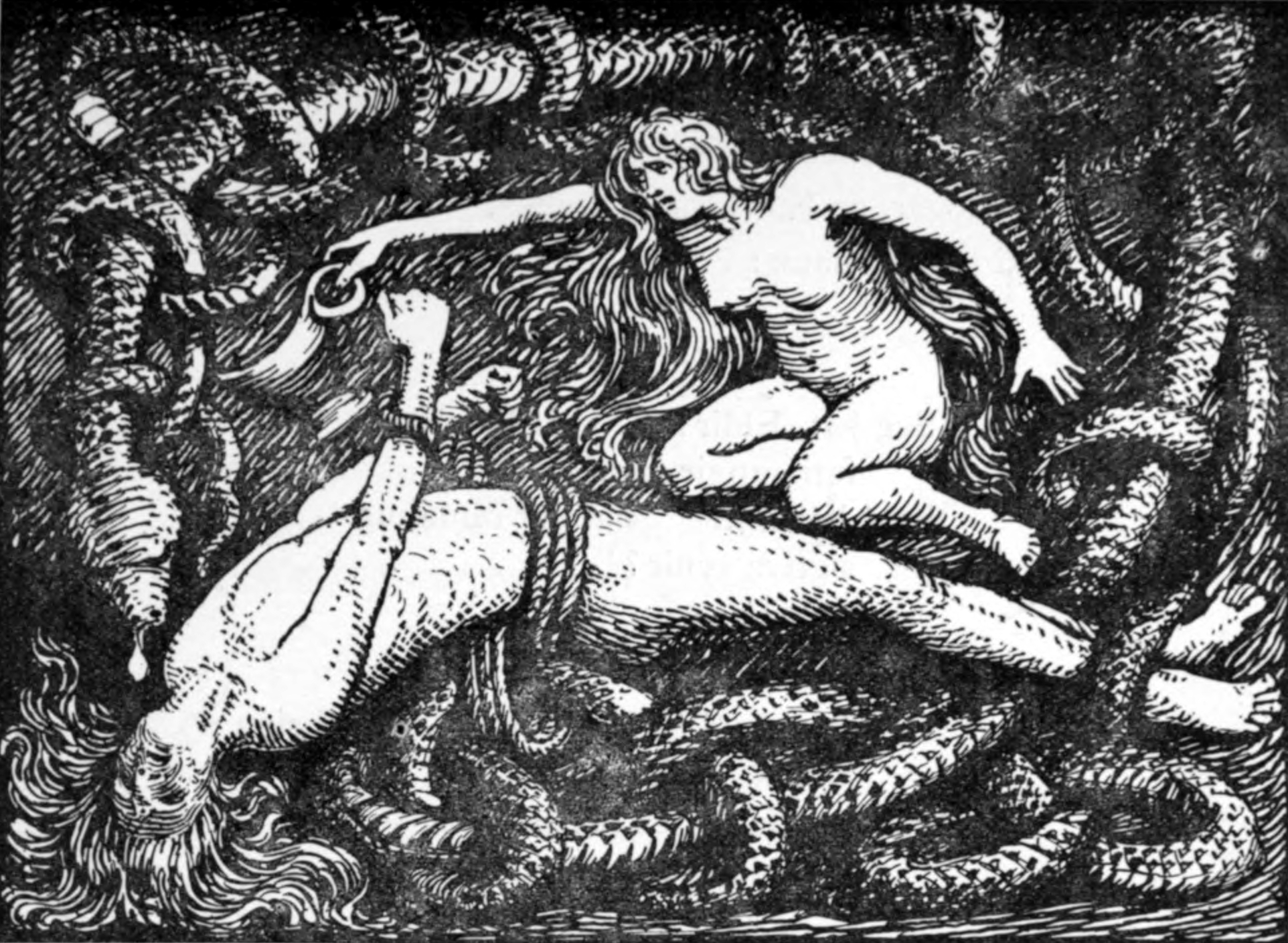
This time around we have a song about one of the females from the Norse Pantheon, Sigyn.  Sigyn is the wife of the Trickster Loki and her name translates as 'Faithful', because that is what she is.  She remains faithful to her husband Loki even when he is bound down in the deepest recesses of Hel(not to be confused with the Christian Hell, which itself is a perversion of one particular realm of the Indo-European afterlife), where he is being punished by the Gods for something he did.  Loki is bound in a stone chair and has a giant snake over him dripping poison onto him.  Sigyn stops the poison from falling on Loki by collecting it in a cup.  This is a true sign of faithfulness: sticking by a husband even when he is an outcast from the community, and even when he is in Hel, and she is doing an awful job (collecting poison).


An image by Collingwood of Loki being punished in Hel.  Sigyn lovingly stays beside him, capturing the poison that a snake continually drips on him.
 
The ability to endure, to persevere and suffer, and to keep doing her job is a sign of her strength of character.  Sigyn is not 'A fair weather friend' or 'A fair weather wife'.  She sticks by her man, her husband, to the bitter end.  That is true faithfulness.  And faithfulness is not something we here much of in the modern world, a world with high divorce rates, which is why I thought it was worth writing about.


Play the song in the music video above and sing along with the alternative lyrics below.


# Faithful to Thee #
Oh ho-uh yeah.
When I hold you Loki,
Feel your heart beat close to me.
Gonna stand by you forever.
I will be faithful to thee.
 
While I stand here right beside you,
In the deep recesses of Hel.
You must know that I will never leave you.
I will be faithful to thee.
 
Faithful to thee.
Faithful to thee.
Faithful to thee.
Faithful to thee.
 
Oh ho-uh yeah.
I collect this venomous poison.
Before it drips right down on you.
'cause I can't stand to hear you hurting.
I will be faithful to thee.
 
Faithful to thee.
Faithful to thee.
Faithful to thee.
Faithful to thee.

Oh ho-uh yeah.
Uh uh ho-oh yeah.
Oh ho-uh yeah.
Uh uh ho-oh yeah.
Oh ho-uh yeah.
Uh uh ho-oh yeah.
Oh ho-uh yeah.
Uh uh ho-oh yeah.
 
Faithful to thee.
Oh ho-uh yeah.
Uh uh ho-oh yeah.
Faithful to thee.
Oh ho-uh yeah.
Uh uh ho-oh yeah.
Faithful to thee

Oh ho-uh yeah.
Uh uh ho-oh yeah.
Faithful to thee.
Oh ho-uh yeah.
Uh uh ho-oh yeah.
 
Oh ho yeah.
When I hold you Loki,
Feel your heart beat close to me.
Gonna stand by you forever.
I will be faithful to thee.
 
Oh ho-uh yeah.
Uh uh ho-oh yeah.
Oh ho-uh yeah.
Uh uh ho-oh yeah.
Oh ho-uh yeah.
Uh uh ho-oh yeah.
Oh ho-uh yeah.
Uh uh ho-oh yeah.

 
Faithful to thee.
Oh ho-uh yeah.
Uh uh ho-oh yeah.
Faithful to thee.
Oh ho-uh yeah.
Uh uh ho-oh yeah.
Faithful to thee.
Oh ho-uh yeah.
Uh uh ho-oh yeah.
Faithful to thee.
Oh ho-uh yeah.
Uh uh ho-oh yeah.


[End of lyrics.]

Sunday, 22 December 2013

Havamal Snippets 112: At night time, sleep!


This verse strikes me as the only unnecessary verse I've encountered so far in the Havamal.  Do we really need to be told not to get up in the night?  I don't know, maybe I'm missing something.
 
There are some other verses that mention that night-time is for sleeping: 23 which reminds us that staying awake at night worrying isn't good; 58 and 59 remind us that night is for sleeping and day is for working; 113 advises us not to sleep in the arms of a woman skilled in magic (magic includes vartious skills including what modern people would call psychological tricks).

 
112
Ráðumk þér Loddfáfnir
en þú ráð nemir
njóta mundu ef þú nemr
þér munu góð ef þú getr
nótt þú rísat
nema á njósn sér
eða þú leitir þér innan út staðar       
 
I advise you, Loddfafnir,
to take advice;
you would benefit, it you took it,
good will come to you, if you accept it:
don't get up at night,
unless you are on guard
or are seeking a place outside for yourself.

[End.]