Friday, 24 October 2014

Men of Yore: Nikolai Benardos

This is another in a series of posts about men from history who have either achieved great things in one form or another by pushing boundaries: either in themselves or in society or science or exploration of some form. Boundary pushing and growth is what men do, it's their nature: to grow and push outwards. We, as men, are the frontiers men, the first to discover/uncover new territory, in a metaphysical sense (i.e. including both material and the immaterial) that is later colonised and 'civilised' by the rest of humanity.


Nikolai Benardos
 
Benardos, Nikolai Nikolaevich

Born June 26 (July 8), 1842, in the village of Benardosovka, Kherson Province; died Sept. 8 (21), 1905, in Fastov, Kiev Province. Russian inventor, originator of electric arc welding.

Benardos studied at the University of Kiev and at the Petrov Agricultural and Forestry Academy in Moscow. Beginning in 1865 he made and, in part, patented in Russia and abroad more than 100 inventions in the most varied areas (agriculture, transportation, and others). In 1882 he proposed a procedure for “connecting and disconnecting metals by the direct action of an electric current” (which he named “elektrogefest”). In 1885 he patented his invention in Germany, France, Russia, Italy, England, the USA, Belgium, and other countries. The characteristic feature of this method was the utilization of the electric arc arising between a carbon electrode or one of another conductive substance and the articles processed. “Elektrogefest” was immediately used in Russia as well as abroad (in railroad workshops and in machine-building and metallurgical plants). Benardos built a special type of electrical storage battery to supply the continuous high current necessary for welding.

Benardos was also the first to invent welding with an indirect arc, welding in a gas stream, arc cutting both in ordinary conditions and under water, and the electrolytic method of coating large metal surfaces with copper. Among Benardos’ other inventions was a thermal method for electrical soldering. He created carbon electrodes of the most varied forms and electrodes made of a combination of carbon and metal. He offered one of the first designs for an alternating current hydroelectric power plant on the Neva River (1892). At the Fourth Electrical Exhibit in St. Petersburg in 1892, Benardos was awarded the highest award of the Russian Technical Society, the gold medal, for the successful utilization of the arc in his electrical welding invention. In 1899 the Electrical Engineering Institute in St. Petersburg awarded him the title of honorary electrical engineer.

Source: http://encyclopedia2.thefreedictionary.com/Nikolai+Nikolaevich+Benardos
 
Amongst 100 or more other inventions, Nikolai Bernados is credited with developing is arc-welding; a relatively un-exciting process whereby two pieces of metal are joined together.  But when you think of all the structures that you come into physical contact with on a day-to-day basis (cars, bridges, sky-scrapers etc) that have been arc-welded together then it's importance becomes much more apparent.  Even more so when you take a mental step-back and think of all the ships, rail locomotives, lorries, buildings, machinery and innumerable other devices that sustain civilisation (and the people that live in it) that have been welded together.

Making discoveries like this isn't gonna make you popular with the 'in crowd' or hipsters or girls or the chattering classes, they aren't interested in either the science & technology (unless it's trendy to be a techie) or the possibilities that it could bring (like increased productivity and freedom and human self-expression/creativity).  They are only concerned with the fruits of yours, or someone elses, labour, and they often see these fruits as impersonal 'things'/'objects' rather than as personal discoveries/creations, which causes them to have little respect for the fruit or the inventor/person who created it.  But these people aren't important.  What is important is that you're enjoying what you do, like the inventors did, like Nikolai did; that you're enjoying your work, you're work that you've engrossed yourself in (whatever it may be).  That's all that matters.  That's what inventors and innovators and other such men of science and industry do: they do what they enjoy doing and we can see what great things they resulted because of that love.


[End.]
 

Wednesday, 22 October 2014

Alternative Lyrics to Well Known Songs 31 - Ebola

(Based on the song 'Blockbuster' by The Sweet).

This 'alternative lyrics' post is a parody of the scaremongering about Ebola that is going on in the SM (and some 'alternative news outlets' presently.

Fear-mongering is something that the MSM get up to every time a new virus hits the global scene.  Think back a few years to Swine Flue, then Bird/Avian Flu, and so on.  All of these scare-mongering stories about 'imminent viral pandemics' that have popped up over the years have amounted to nothing.  Not the next Spanish flu, not the next Black Death, not anything major to get stressed/anxious about.  If anything it's shown that all that the MSM seem to care about is finding the latest, newest (trendiest ?!) virus and claiming that it might 'go global' and cause umpteen gazillion blood-curdlingy nasty deaths around the world; ergo, you should be afraid!  Fear which should drive you to keep watching their news!  It does nothing but cause more panic, unthoughtful panic, which is no good thing.  And frankly there's enough doomer-style global-scale fear-mongering going on around that is already unjustified: colony collapse disorder, killer bees, shoe bombs, and lord knows what else.  All that these stories do is cause you to be fearful and/or pessimistic that 'the end of the world is nigh'; and we, as men, don't really need any more of that.  We've got enough mental stress as it is! (Stress is one of the contributing factors to heart problems which men suffer from more than women.)  We don't need any more stress thank you very much.  Enough with the pessimism and the fear-mongering; especially those who are sensitive and easily effected by pessimistic stories.

So whenever you encounter one of these fear-mongering stories that emphasise 'terrible things that MIGHT happen', just roll your eyes and shake your head at them and the people who peddle them, because they're not worth your attention.

Oh, and finally, the lyrics in this song themselves are written from the perspective of the newsreader.  Just imagine a familiar newsreader reading them out in an absurd comedic fear-mongering way and it should have the desired effect.  The comedy element also ties in with the light-hearted comedic music - which is 1970's glam-rock!  Check out that eye-liner and psychadelic colours!  Yikes!


Play the music video above and sing along using the alternative lyrics given below.


# Ebola #You'd better beware, you'd better take care.
You'd better avoid people from Lib-e-ria!
Don't use your mind, obey government line.
You'd better not fly on any airlines!

Listen to our noise, for we are wise,
even if it contradicts what you-see with your eyes.
Only we know, where Ebola goes,
it could strike any neighbourhood including your own!

We spoke to an expert today, here's what he did say:
"We just haven't got a clue what to do!"
Anyone should be scared, are you dear viewer scared?
Of Ebola!

Reporters are out, their squaking about
The global-wide pandemic that is imminent:
"It's gotta be caught, or it's gonna be fraught.
'Cause it's gonna kill more people than all world wars have wrought."

We spoke to an expert today, here's what he did say:
"We just haven't got a...  Ah-h!"
Anyone should be scared, are you dear viewer scared?
Of Ebola!

We spoke to an expert today, here's what he did say:
"We just haven't got a clue what to do!"
Anyone should be scared, are you dear viewer scared?
Of Ebola!

Bola, bola, Ebola.
Bola, bola, Ebola.
Bola, bola, Ebola.


[End.]

Saturday, 11 October 2014

Men of Yore: Joseph Aspdin

This is another in a series of posts about men from history who have either achieved great things in one form or another by pushing boundaries: either in themselves or in society or science or exploration of some form. Boundary pushing and growth is what men do, it's their nature: to grow and push outwards. We, as men, are the frontiers men, the first to discover/uncover new territory, in a metaphysical sense (i.e. including both material and the immaterial) that is later colonised and 'civilised' by the rest of humanity.


Joseph Aspdin

Aspdin, Joseph (bap. 1778, d. 1855), cement maker, was baptized on 25 December 1778 in Hunslet, Leeds, the eldest in the family of five sons and one daughter of Thomas Aspdin, bricklayer of Hunslet, and his wife, Mary. Aspdin followed his father's trade of bricklayer and builder at Briggate, Leeds. On 21 May 1811 he married Mary Fotherby at Hunslet. They had two sons and five daughters, two of whom died in infancy.

Aspdin's experiments with cement making led him to apply for a patent, which was granted in June 1824, for ‘An improvement in the modes of producing an artificial stone’—the first patent to be granted which used the term ‘portland cement’.

Cement is the term in common use for a powder which hardens when mixed with water and is used to bind together aggregates of gravel and stone to produce concrete. In the second half of the nineteenth century portland became the most popular type of cement and it has been used in vast quantities for building and construction in all parts of the world. In Aspdin's day cement manufacture was undergoing relatively rapid development and many experimenters were working in the field. Aspdin took the name for his patent material from portland stone, which had a high reputation and provided a standard with which artificial products would naturally be compared. To produce the high strengths associated with modern portland cement it was necessary to burn at high temperatures finely pulverized lime with clay in certain proportions, and grind the product. It is uncertain when Aspdin made this breakthrough. He may have used a glasshouse kiln, which would be more likely to reach the high temperatures required for successful burning of portland cement than the lime-burning kiln used by his competitors. There was a glassworks at Hunslet at this time and a glassworks and foundries at Wakefield.

Aspdin set up a partnership in 1824 with a neighbour, William Beverley, as ‘patent portland cement manufacturers’, operating from Leeds and Wakefield, to where Aspdin moved, and later expanded to an agency at Liverpool. The partnership ended in 1837, and Aspdin recommenced manufacture with his two sons, James and William, at a nearby site in Kirkgate, Wakefield, and took James into partnership three years later. When Aspdin retired in 1844, James continued the business.

William Aspdin moved to London in 1841, forming a succession of partnerships to make portland cement at Rotherhithe, Northfleet, and Gateshead upon Tyne in England, and Hamburg in Germany. It appears that his father deliberately excluded him from the family business, but despite this William was an enthusiastic advocate, often with exaggeration, of the superior qualities of portland cement.

Aspdin died at his home in Hansons Terrace, Wakefield, on 20 March 1855 and was buried in St John's churchyard, Wakefield. A tablet to his memory was unveiled in Leeds town hall in 1924. 
(Source: http://www.oxforddnb.com/view/article/37129)

Concrete is often derided as a building material because of the poorly designed and un-aesthetic buildings that have been built out of from the 1950s onwards (both in the tower blocks of the Communist East and the shopping centres of the Capitalist West).  However that is not the fault of concrete, or the men who conceived it, but rather the architects who made poor use of it.  It is an outstanding and versatile building material as we can see practically everywhere, both indoors and outdoors.  It can be manufactured easily (Aspdin made the first Portland cement in his kitchen), shaped easily to suit many many purposes easily, and easily recyclable when it's lifecycle has ended.  You can't ask for much more than that from a building material!

It should also be noted that while Aspdin is credited with being the inventor of Portland Cement he is one link in a long chain of men who made their own unique innovations (as personal, individual discoveries) and thus contributions to the development of cement, men who lived before Aspdin and came after him as well, one link in an important chain that stretches on to this day and potentially in to the future.


[End.] 

Saturday, 4 October 2014

Men of Yore: Peter Henlein

This is another in a series of posts about men from history who have either achieved great things in one form or another by pushing boundaries: either in themselves or in society or science or exploration of some form. Boundary pushing and growth is what men do, it's their nature: to grow and push outwards. We, as men, are the frontiers men, the first to discover/uncover new territory, in a metaphysical sense (i.e. including both material and the immaterial) that is later colonised and 'civilised' by the rest of humanity.

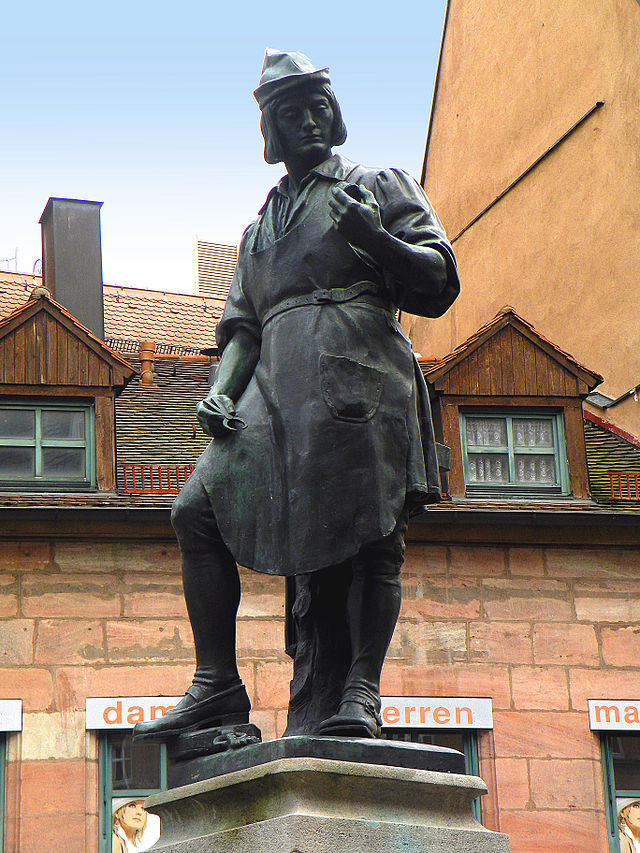
Peter Henlein (A Franz Meiss Statue in Nuremburg)


Peter Henlein (also spelled Henle or Hele)[1] (1485 - August 1542), a locksmith and clockmaker of Nuremberg, Germany, is often considered the inventor of the watch.[2][3] He was one of the first craftsmen to make small ornamental taschenuhr, portable clocks which were often worn as pendants or attached to clothing,[4] regarded as the first watches. Many sources also erroneously credit him as the inventor of the mainspring.[1][5][6][7]

Little is known about Henlein's life. He apparently apprenticed in his youth as a locksmith. At the time, locksmiths were among the few craftsmen with the skills and tools to enter the new field of clockmaking,[8] and Henlein also became a clockmaker. On September 7, 1504, he was involved in a brawl in which a fellow locksmith, George Glaser, was killed. He sought asylum at a local Franciscan monastery, where he stayed for four years, until 1508. In 1509 he became a master in the city's locksmith guild.[2] He became known as a maker of small portable ornamental spring-powered brass clocks, very rare and expensive,[2] which were fashionable among the nobility of the time. These were sometimes worn as pendants or attached to clothing,[9] and so may be considered the first watches, although at over 3 inches long[4] they were bigger than the first true pocketwatches which appeared about a century later, and were not able to fit in pockets. He is mentioned in the city's records as the supplier of small spring-driven clocks, which were given as gifts to important people.[2] He was supposedly the first craftsman to build clockworks into "Bisamkopfe", small containers fashioned from precious metals for fragrances or disinfectants.[2] For example a Nuremberg paper records that in 1524 he was paid 15 florins for a gilt musk-ball watch.[10] He also built a tower clock for Lichtenau castle in 1541, and was known as a maker of scientific instruments.[2]
 
Henlein's fame is mostly due to a passage by Johann Cochläus in the 1511 Cosmographia by Pomponius Mela:[1][2]
Peter Hele, still a young man, fashions works which even the most learned mathematicians admire. He shapes many-wheeled clocks out of small bits of iron, which run and chime the hours without weights for forty hours, whether carried at the breast or in a handbag
His reputation as the inventor of the watch came after his rise to popular consciousness in the 19th century, through a novel by Karl Spindler, Der Nürnberger Sophokles.[2] This was made into a 1939 film, and his likeness appeared on a 1942 German stamp.[2] However, although he was a notable and talented clockmaker, there were other clockmakers making small clocks at the time,[3][8][10] and no contemporary source from his time credits him with inventing anything.[2] The mainspring which made portable clocks possible, often attributed to him,[1][5][6][7] actually appeared in the early 1400s, almost a century before his work.[11][12] Perhaps the most that was said of him by his peers comes from Johann Neudorfer in 1547 shortly after his death:[2]
This . . . Henlein was very nearly the first of those who invented how to put small clocks into little boxes.
Source: http://en.wikipedia.org/wiki/Peter_Henlein

Being able to accurately know the time is something we take for granted in modern life.  After all clocks and timepieces are everywhere: wrist watches, wall clocks, i-pods, radios, clock-towers, parking machines, bus stops, railway stations, etc etc.  But someone had to first conceive of a mechanical device that could tell the time, Peter Henlein was one of those men.  He may not have been the first clock maker nor made any great innovations in clock-making but he did design and make small clocks that could be easily carried around, thereby making the clock a more practical device; a device that could be used in a number of geographical locations rather than being fixed to one particular spot.  Which is useful in the same way that many things are more useful when they are mobile rather than stationary (e.g. engines/motors, communication devices, computers etc).


[End.]

Saturday, 27 September 2014

Men of Yore: Robert Hooke

This is another in a series of posts about men from history who have either achieved great things in one form or another by pushing boundaries: either in themselves or in society or science or exploration of some form. Boundary pushing and growth is what men do, it's their nature: to grow and push outwards. We, as men, are the frontiers men, the first to discover/uncover new territory, in a metaphysical sense (i.e. including both material and the immaterial) that is later colonised and 'civilised' by the rest of humanity.


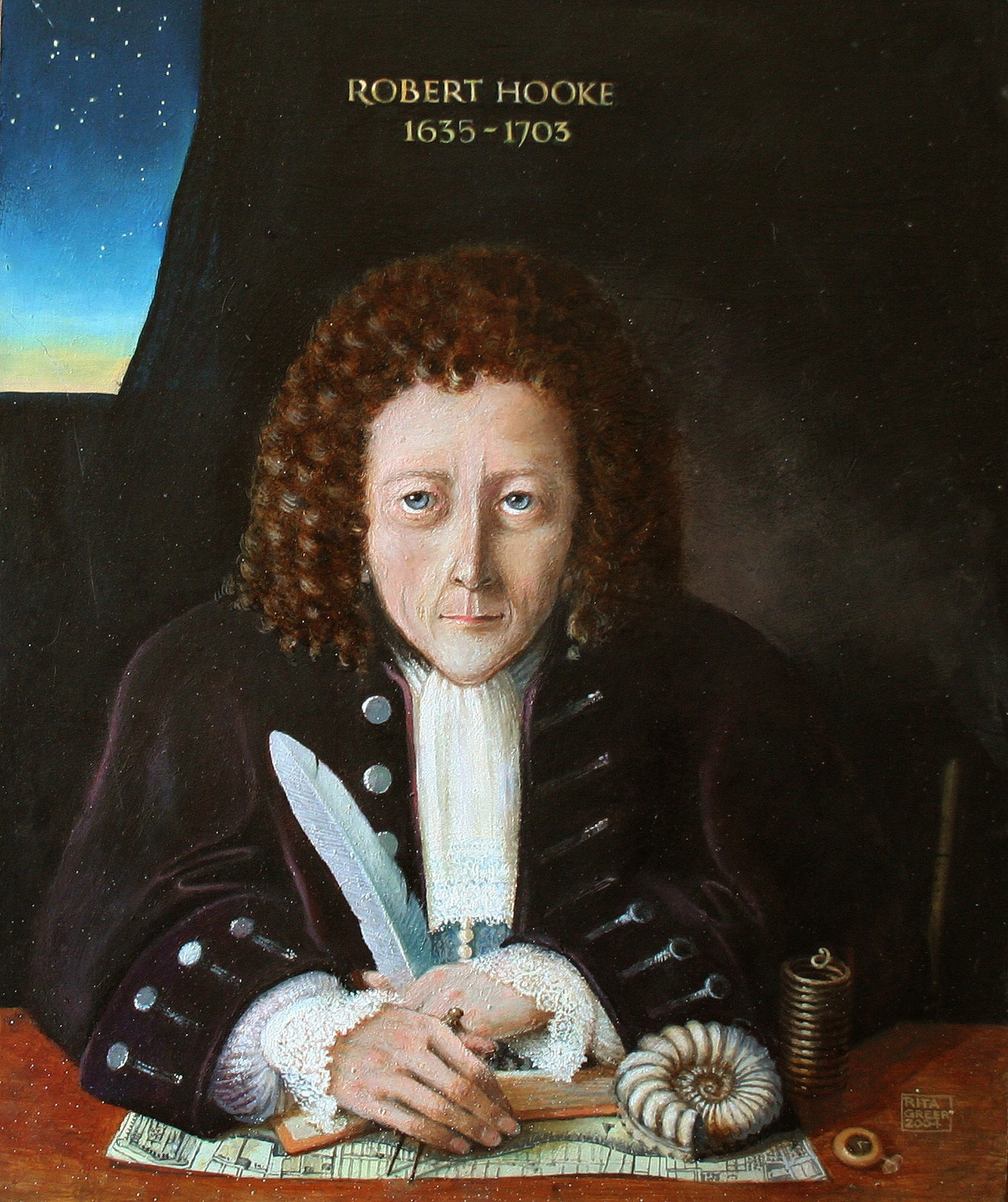
An artists impression of Robert Hooke.  (There is no known image of him.)


The British natural philosopher, architect and polymath, Robert Hooke is perhaps the most neglected natural philosophers of all time despite the significant role he played in the scientific revolution. His prominent contributions include: the iris diaphragm in cameras, the universal joint used in motor vehicles, the balance wheel in a watch, the origination of the word ‘cell’ in biology, he was Surveyor of the City of London after the Great Fire of 1666, architect, experimenter, worked in astronomy – yet is acknowledged mostly for Hooke’s Law.

His name is somewhat obscure today, due in part to the hostility of his well-known and dominant colleague, Sir Isaac Newton.


Early Life:
Robert was born on the 18th of July 1635 at Freshwater, in the Isle of Wight, England. He was the last of the four children of John Hooke and Mirena Blazer. His father was the minister of the Church of England. Most of his early life, Robert had a poor health due to which he received most of his early education at home from his father, who was also in charge of a local school. As a youth, Robert had a natural curiosity in his surroundings and interest in mechanical works and drawing that he pursued in various ways all through his life.

At the age of thirteen young Hooke was able to enter Westminster School, and from there went to Oxford, where some of the finest scientists in England were working at the time. There he built a good impression with his skills at designing experiments and building equipment. He was appointed as a chemical assistant to Dr Thomas Willis and later met the natural philosopher Robert Boyle, and gained a position as his assistant from about 1655 to 1662.


Contributions and Achievements:
During November 1661 he was appointed curator of experiments to the Royal Society after a proposition made by Sir Robert Murray. In 1664 Sir John Cutler settled an annual gratuity of fifty pounds on the Society for mechanical lectureship and in the following year Robert was nominated professor of geometry in Gresham College, where he later resided. After the Great Fire of 1666 he constructed a model for the rebuilding of the city, which was highly approved, although the design of Sir Christopher Wren was preferred.

Hooke’s contribution to biology is mainly his book Micrographia which was published in 1665. He developed the compound microscope and illumination system (one of the best such microscopes of his time) and used it in his demonstrations at the Royal Society’s meetings. Using it he also observed organisms as varied as insects, sponges, bryozoans, foraminifera, and bird feathers. This was a best-seller during his time.

His other contributions include: the law of elasticity, attracting principle of gravity, he resolved the problem of the measurement of the distance to a star, it was him who actually created the air pump on which Boyle’s experiments could be conducted, etc.


Death:
This inspirational founder of modern science passed away on March 3, 1703 in London, England.

Source: http://www.famousscientists.org/robert-hooke/

An example of a polymath, whose interests ranged from urban planning (re-designing a whole capital city no less!), to astronomy, to micro-biology.  Some mens lives tend towards focussing on one particular field while other men (like Robert Hooke) take interest in many fields.  No one particular path is the 'right way' and is thus superior to the other.  Both paths are equally valid and should be equally valued.  Which means that the men who choose one path instead of the other should also be valued: the high-IQ, high-earning polymath working in the university who studies many things is equally as valuable as the moderate-IQ, moderate-earning paper-make who repetitively performs the same task over and over again (and supplies the scientist with the paper he needs to do his will).  Both perform a taks that is beneficial to themselves and to the other man.


[End.]

Saturday, 20 September 2014

Men of Yore: Jean Piaget

This is another in a series of posts about men from history who have either achieved great things in one form or another by pushing boundaries: either in themselves or in society or science or exploration of some form. Boundary pushing and growth is what men do, it's their nature: to grow and push outwards. We, as men, are the frontiers men, the first to discover/uncover new territory, in a metaphysical sense (i.e. including both material and the immaterial) that is later colonised and 'civilised' by the rest of humanity.

Jean Piaget


Jean Piaget was born on August 9, 1896, in Neuchâtel, Switzerland. Over the course of his career in child psychology, he identified four stages of mental development, called “schema.” He also developed new fields of scientific study, including cognitive theory and developmental psychology. Piaget received the Erasmus Prize in 1972 and the Balzan Prize in 1978. He died on September 16, 1980, in Geneva, Switzerland.  

Early Life
Biologist and psychologist Jean Piaget was born on August 9, 1896, in Neuchâtel, Switzerland. He was his parents’ first child. Piaget’s mother, Rebecca Jackson, attributed his intense early interest in the sciences to his own neurotic tendencies. Yet Piaget’s father, a medieval literature professor named Arthur, modeled a passionate dedication to his studies—a trait that Jean Piaget began to emulate from an early age. At just 10 years old, Piaget’s fascination with mollusks drew him to the local museum of natural history, where he stared at specimens for hours on end. When he was 11 and attending Neuchâtel Latin High School, Piaget wrote a short scientific paper on the albino sparrow. By the time he was a teen, his papers on mollusks were being widely published. Piaget’s readers were unaware of his age and considered him an expert on the topic.

After high school, Piaget went on to study zoology at the University of Neuchâtel, receiving his Ph.D. in the natural sciences in 1918. In 1918, Piaget spent a semester studying psychology under Carl Jung and Paul Eugen Bleuler at the University of Zürich, where Piaget developed a deeper interest in psychoanalysis. Over the course of the next year, he studied abnormal psychology at the Sorbonne in Paris.
 
Psychological Studies
In 1920, working in collaboration with Théodore Simon at the Alfred Binet Laboratory in Paris, Piaget evaluated the results of standardized reasoning tests that Simon had designed. The tests were meant to measure child intelligence and draw connections between a child’s age and the nature of his errors. For Piaget it raised new questions about the way that children learn. Piaget ultimately decided that the test was too rigid. In a revised version, he allowed children to explain the logic of their "incorrect" answers. In reading the children’s explanations, he realized that children’s power of reasoning was not flawed after all. In areas where children lacked life experience as a point of reference, they logically used their imagination to compensate. He additionally concluded that factual knowledge should not be equated with intelligence or understanding.

Over the course of his six-decade career in child psychology, Piaget also identified four stages of mental development, called Schema. The first is the "sensorimotor stage," which involves learning through motor actions, and takes place when children are 0–2 years old. During the "preoperation stage," children aged 3–7 develop intelligence by using their natural intuition. During the "concrete operational stage," children 8–11 develop cognitively through the use of logic that is based on concrete evidence. "Formal operations," the fourth and final stage, involves 12-to-15-year-olds forming the ability to think abstractly. Piaget called his collective theories on child development "Piaget’s Genetic Epistemology."
 
Death and Legacy
Jean Piaget died of unknown causes on September 16, 1980, in Geneva, Switzerland. He was 84 years old. His body rests at the Cimetière des Plainpalais.

Piaget is responsible for developing entirely new fields of scientific study, including cognitive theory and developmental psychology. The recipient of the prestigious Erasmus (1972) and Balzan (1978) prizes, he summed up his passion for the ongoing pursuit of scientific knowledge with these words: "The current state of knowledge is a moment in history, changing just as rapidly as the state of knowledge in the past has ever changed and, in many instances, more rapidly."

Source: http://www.biography.com/#!/people/jean-piaget-9439915#synopsis

Empathising with children is something that I think we can all agree is, on the whole, a good thing as it allows us to make there lives on planet Earth more pleasant than they otherwise might be.  If we didn't empathise with them and see the world from their perspective then we would see them as more like other material possessions.  Material possessions which could either be good, like economic resources (e.g. child labour) or pets (e.g. child-pageants), or material possessions which could be bad inconvenient (e.g. abortions) or an annoyance (e.g. corporal punishment).  None of these perspectives are human/humane ones.

Thankfully though we see, or are beginning to see, children as more than material possessions and as (relatively) autonomous human beings who have thoughts and feelings of their own.  Jean Piaget was one of the men who was responsible for this change in perspective, to viewing children in a more positive light and treating them as human beings rather than possessions who can be filled with data, or dressed up and put on a stage, or whatever.


[End.]

Monday, 15 September 2014

Alternative Lyrics to Well Known Songs 30 - Bream

(Based on the song 'Dream' by the Everly Brothers)

As promised last week, here's a light-hearted post for you.  It's an alternative lyrics post based on a sedate hobby which is popular among many men: fishing.


Play the music video above and sing along with the alternative lyrics provided below.


# Bream # 
Brea-ea-ea-ea-eam
Bream, bream, bream, brea-ea-ea-ea-eam
bream, bream, bream how I want you
in my pond's where I want you
on my hook and fishing net too
All I want to catch is brea-ea-ea-ea-eam
Bream, bream, bream's what I need to
to bite my fly, I really want to
to feel the bite and reel you right in.
All I want to catch is Brea-ea-ea-ea-eam.

I want you on my line
Biting on my fly.
Sunday,
afternoon.
All this means is,
oh yes,
I'm fishin' my Sunday's away.

I need you so
no fish compares to you oh no.
And that is why
Whenever I want fish, all I strive to catch
is Brea-ea-ea-ea-eam.
Bream, bream, bream, brea-ea-ea-ea-eam

I want you on my line
Biting on my fly.
Sunday,
afternoon.
All this means is,
oh yes,
I'm fishin' my Sunday's away.

I need you so
no fish compares to you oh no.
And that is why
Whenever I want fish, all I strive to catch
is Brea-ea-ea-ea-eam.
Bream, bream, bream, brea-ea-ea-ea-eam
[Fade out.]


[End of Lyrics.]

Wednesday, 10 September 2014

Alternative Lyrics to Well Known Songs 29 - There are People in Ukraine

(based on the song 'Hanging on a Rope' by Rocket from the Crypt)
(Foreword: I'm not totally happy with the lyrics in this one, they're a tad rough 'n' ready, and are lacking in something, but I can't quite pin it down.  I'll post them anyway and update them if some inspiration comes to me at a later date.)

As I'm sure you're all aware by now media outlets are mouthpieces of the Empires they are employed by.  In the case of the West we have media outlets which are employed by an Empire which is misandric, anti-Russian, anti-white, pro-Israel, pro-multiculturalism and so on.  What this means, amongst other things, is that people (human beings like thee and me) presented in news programmes are treated as little more than political pawns used to further the Empire's agenda.  Whether it's Cliff Richard being used to portray old White men as paedophiles, or Jessica Ennis being used to portay mixed-race women as super-human, or the murder of Alexander Litvinenko being used to portray Russia as evil, one tactic is always the same: using people as tools to further the Empire's agenda.  In the process the people being used are de-humanized and treated as nothing more than 'things'.  The media doesn't engage with them on a human level, nor does it want you to engage with them on a human level.  This tactic is evident in the Summer of 2014 in the reporting of the Ukrainian Civil War, which is used by Western media as a vehicle to peddle the Wests hatred of Russia and it's particular hatred of Putin.  The plight of the Ukrainian people is of no consequence to the media in the West.  The Ukrainian people are used like children in a custody battle between two bitter divorcees who are merely using the children to get back at their partner for some minor offence.  It's disgusting, really disgusting.

A corrupt media de-humanizing people and using them to further their own Imperialistic, anti-human agenda, that about sums it up.  It's pretty depressing really.  Sorry there's no positive vibe to end on.  I'll make sure to have a lighter post next week.

Play the song in the video above and sing along with the alternative lyrics given below.


# There are People in Ukraine # You switch on the TV and you watch the news and you hear what they do say:
The presenter speaks about Ukraine and how it's the fault of Vlad Putin.

(in Ukraine, in Ukraine, there are people in Ukraine.)
Ukraine.
(in Ukraine, in Ukraine, there are people in Ukraine.)
Ukraine.
(in Ukraine, in Ukraine, there are people in Ukraine.)
Ukraine.
(in Ukraine, in Ukraine, there are people in Ukraine.)
Ukraine.
(in Ukraine, in Ukraine, there are people in Ukraine.)

It's the same old story that the mainstream media tries to peddle to you again:
About the 'Evil Putin' is about to enlargen the scarey 'Russian Empire'.
The mainstream media totally forgets about the people of the Ukraine.
About the bombs, and the shells and the razed tower blocks of people like you and me.

(in Ukraine, in Ukraine, there are people in Ukraine.)
Ukraine.
(in Ukraine, in Ukraine, there are people in Ukraine.)
Ukraine.
(in Ukraine, in Ukraine, there are people in Ukraine.)
Ukraine.
(in Ukraine, in Ukraine, there are people in Ukraine.)
Ukraine.
(in Ukraine, in Ukraine, there are people in Ukraine.)
Ukraine.
(in Ukraine, in Ukraine, there are people in Ukraine.)
Ukraine.
(in Ukraine, in Ukraine, there are people in Ukraine.)
Ukraine.
(in Ukraine, in Ukraine, there are people in Ukraine.)

Here me now as I say,
the media is not interested in people.
All it's interested in,
is spewing it's filthy propaganda.

No!
No!
No!
Please No!

(in Ukraine, in Ukraine, there are people in Ukraine.)
Ukraine.
(in Ukraine, in Ukraine, there are people in Ukraine.)
Ukraine.
(in Ukraine, in Ukraine, there are people in Ukraine.)
Ukraine.
(in Ukraine, in Ukraine, there are people in Ukraine.)
Ukraine.
(in Ukraine, in Ukraine, there are people in Ukraine.)
Ukraine.
(in Ukraine, in Ukraine, there are people in Ukraine.)
Ukraine.
(in Ukraine, in Ukraine, there are people in Ukraine.)
Ukraine.
(in Ukraine, in Ukraine, there are people in Ukraine.)

[End of lyrics.]

Friday, 5 September 2014

Men of Yore: John Fitch

This is another in a series of posts about men from history who have either achieved great things in one form or another by pushing boundaries: either in themselves or in society or science or exploration of some form. Boundary pushing and growth is what men do, it's their nature: to grow and push outwards. We, as men, are the frontiers men, the first to discover/uncover new territory, in a metaphysical sense (i.e. including both material and the immaterial) that is later colonised and 'civilised' by the rest of humanity.

John Fitch
 

John Fitch; (1743-1798), American inventor, who designed and built the first operable steamboat. He was born in East Windsor, Conn., on Jan. 21, 1743, the younger son of a farmer. Fitch left school at the age of eight, proved to be physically unfit for farm work, and after unsatisfactory apprenticeships to two clockmakers, set up a brass shop. He failed in this business, and after serving in the Revolutionary War (during which he had charge of a gun factory), he invested his money with little success in the Northwest Territory. 
In 1785, Fitch turned his attention to a steamcoach project and later in the same year tried vainly to get congressional support for operating steamboats on the Mississippi River. During 1786 and 1787 he secured 14-year steamboat monopolies, first in New Jersey and then in Delaware, New York, Pennsylvania, and Virginia. Helped by Henry Voight, a clockmaker, he built a boat with rows of side paddles that were powered by a steam engine, and demonstrated it at Philadelphia before members of the Constitutional Convention in 1787. It moved at a speed of about 4 miles (6.4 km) per hour. 
In 1790, Fitch built a larger boat with a more powerful steam engine and a stern paddle wheel. This steamboat traveled at a speed of 6 miles (9.6 km) per hour in regular service on the Delaware River. Fitch obtained a patent for the steamboat in 1791, but the passenger and freight business was insufficient for commercial success. 
In 1793, Fitch went to France, and although he had a French patent, he was unable to secure backing for his ideas. After his return to the United States he exhibited a small steamboat with a screw propeller, for which he failed to get backing. Lacking the ability to make his inventions pay, he died disappointed and destitute in Bardstown, Ky., on July 2, 1798. 
Source: http://www.rugusavay.com/john-fitch-biography-and-inventions 
 
Steam Locomotive
While living in Kentucky, Fitch continued to work on steam engine ideas. He built two models, one of which was lost in a fire in Bardstown. The other was found in the attic of his daughter's house in Ohio in 1849. The model still exists at the Ohio Historical Society Museum in Columbus.[7] In the 1950s, experts from the Smithsonian Museum examined it and concluded that it was "the prototype of a practical land-operating steam engine," meant to operate on tracks – in other words, a steam locomotive.[8]
In 1802, the Englishman Richard Trevithick invented a full-size steam locomotive that, in 1804, hauled the world's first locomotive-hauled railway train, and within a short time the British invention led to the development of actual railways. Americans began importing English locomotives and copying them.[9] 
Legacy
His legal dispute over state monopoly rights with fellow steamboat inventor James Rumsey and others helped bring about the enactment of the first Patent Act of 1790. He is mentioned in the personal letters of several historical figures including George Washington,[10] Benjamin Franklin,[11] Thomas Jefferson, and James Madison.[12] 
 
 
John Fitch, proving that well known old saying: 'If first you don't succeed, then try, try, try something else...'.  He was unsuccessful as a farmer, unsuccessful as a clockmaker, unsuccessfully working in a brass shop, and then unsuccessful as an investor.  Eventually, aged 42, he stopped copying/imitating other peoples devices/occupations and tried inventing and making his own contraptions, and became successful at it.  Some people (innovators, inventors and that kind of ilk) are better suited to making what they want to make rather than making what other people want.  In the case of John Fitch he excerised his creative spark, his Will, in the form of steam engine powered vehicles: the steam-powered boat and the steam-powered locomotive/railway engine.
 
 
[End.]

Friday, 29 August 2014

Men of Yore: Linus Yale Jr

This is another in a series of posts about men from history who have either achieved great things in one form or another by pushing boundaries: either in themselves or in society or science or exploration of some form. Boundary pushing and growth is what men do, it's their nature: to grow and push outwards. We, as men, are the frontiers men, the first to discover/uncover new territory, in a metaphysical sense (i.e. including both material and the immaterial) that is later colonised and 'civilised' by the rest of humanity. 


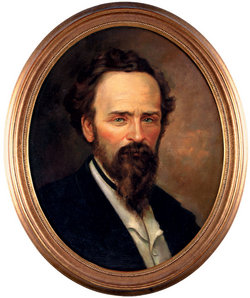
Linus Yale Jr.
 
Birth: Apr. 4, 1821, Salisbury, Herkimer County, New York, USA
Death: Dec. 25, 1868, New York, New York County (Manhattan), New York, USA


He was born in Salisbury, Herkimer county, N.Y., April 4, 1821. As a boy he showed an aptitude for art. At the age of sixteen he got from a traveling portrait painter a few hints on the use of colors, and this was all the direct instruction he ever received. He soon after became a professional portrait painter, and followed his calling until 1851. He was married in 1844. He never made a disagreeable picture. He had the faculty of choosing the sitter's best moment; his dye was guided by his imagination, and his hand governed by cool discretion. His portraits are like and life-like. He diffused through them his own quality, subtilizing and ennobling. He loved nature, and had a knowledge of rocks and trees beyond science. "Do you know that wood?" he said once, pointing to a picture of his, a blackberry girl leaning against a fence. "No other splits in that way." Such was the delicacy and dexterity of his manipulations that in the opinion of one of the first of American sculptors -- the author of the statue of Washington in Union square, New York -- he might have done even better in sculpture than in painting. With all these gifts a great future seemed to be before Mr Yale, when, in his thirtieth year, he invented a bank lock.

His mind had often been engaged by the subject of locks and safes, owing to the fact that his father was an inventor and manufacturer of locks. He was sure of the value of his invention, and thought by a few years' devotion to the getting it before the public to gain a competence with which afterwards to follow his beloved art for its own sake. But, being vexed by the troubles common to inventors, it was not until shortly before his death that he seemed fully to have succeeded. The patience with which he bore the misrepresentations of rivals was wonderful. Once when asked why he did not prosecute a wealthy firm which was thought to have infringed upon an important patent, he said: "I can do better; I have already made a better invention." In 1855 he picked the celebrated Hobbs's lock, so called. The same year he removed to Philadelphia, and in 1861 to Shelburne Falls. Within the last seventeen years he invented not less than thirty devices in locks alone.

Besides his inventions in locks and safes, and in machinery for their manufacture, he was constantly obtaining patents for other devices which he had not time to use. His portfolios show the activity of his brain. Even his diaries are filled with mechanical drawings, made while travelling; often a face or a charming bit of landscape graces a page. A friend, looking at his drawing of a certain instrument, said: "It is astonishing that a common thing can be so glorified." It was done by such minute and delicate touches as not to show a line.

Among his friends Linus Yale was a constant delight. The letters of condolence with his family written by business men are full of admiration and tenderness, and a great grief seems to have settled down on the workmen in his employ. No man of equal merit was ever less known by the public; none loved in a broader private circle. There was sorrow in a thousand hearts when the New York papers announced his death. Gentle, silent, resolute, cultivate, self-respecting, generous, suave and strong -- a gentleman and a genius -- he cannot be allowed to pass away without some tribute of appreciation.

Source: http://www.findagrave.com/cgi-bin/fg.cgi?page=gr&GRid=52830523/ (slightly edited)
 

One of the main reasons for the success of the Linus Yale's locks was down to his use of publicity, as is shown in his wikipedia page:
[H]he did live demonstrations to corporate business executives and government officials that showed how he successfully picked the locks that were in operation. Due to these demonstrations and the sheer quality of Yale’s locks, Yale Lock Manufacturing quickly gained business ground. The company’s name was later changed to The Yale and Towne Manufacturing Company, which eventually became part of NACCO Industries.

Cracking the Hobbs Lock
The prominent bank locks of Yale’s day were the Hobbs or Newell locks. In an effort to present his locks over the continued usage of the Hobbs Locks, Yale contacted notable bankers and set up a live demonstration in which he successfully picked a Hobbs Lock. As described by Samuel Hammond, one of the bankers present at Yale’s demonstration, "[he] proved that the Hobbs lock is able to be picked and demonstrated it using a fake wooden key that he made". [1]

Challenge to the World
As part of Yale’s business plan and effort to promote his Bank Locks, Yale presented a challenge to anyone who dared to pick his bank locks. He offered a $3000 (a hefty sum) reward to potential challengers, in the event that his locks were successfully picked.
Source: http://en.wikipedia.org/wiki/Linus_Yale_Jr
Linus Yale was much like Samuel Colt (the fire-arms manufacturer) in that he was not coy when it came to promoting his own inventions.  Samuel Colt made public demonstrations of his products as did Linus Yale.  Without this element of self-promotion it's unlikely that his products would have become as popular as they did.  While self-promotion might seem like an un-manly activity to engage in, because it tends towards vanity and narccissism, it's important to note that every good idea or invention needs to made known to the public somehow or else it won't be used; ergo some self-promotion/publicity/marketing is an essential at the end of the day.


[End.]