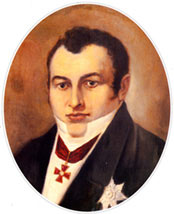
Friday, 4 September 2015

Men of Yore: Rowland Hill

This is another in a series of posts about men from history who have either achieved great things in one form or another by pushing boundaries: either in themselves or in society or science or exploration of some form. Boundary pushing and growth is what men do, it's their nature: to grow and push outwards. We, as men, are the frontiers men, the first to discover/uncover new territory, in a metaphysical sense (i.e. including both material and the immaterial) that is later colonised and 'civilised' by the rest of humanity. 


Rowland Hill


Sir Rowland Hill KCB, FRS (3 December 1795 – 27 August 1879) was an English teacher, inventor and social reformer. He campaigned for a comprehensive reform of the postal system, based on the concept of Uniform Penny Post and his solution of prepayment, facilitating the safe, speedy and cheap transfer of letters. Hill later served as a government postal official, and he is usually credited with originating the basic concepts of the modern postal service, including the invention of the postage stamp.

Early life

Hill was born in Blackwell Street, Kidderminster, Worcestershire, England. Rowland's father, Thomas Wright Hill, was an innovator in education and politics, including among his friends Joseph Priestley, Tom Paine and Richard Price.[1] At the age of 12, Rowland became a student-teacher in his father's school. He taught astronomy and earned extra money fixing scientific instruments. He also worked at the Assay Office in Birmingham[2] and painted landscapes in his spare time.[3]

Educational reform

In 1819 he moved his father's school "Hill Top" from central Birmingham, establishing the Hazelwood School at Edgbaston, an affluent neighbourhood of Birmingham, as an "educational refraction of Priestley's ideas".[4][5] Hazelwood was to provide a model for public education for the emerging middle classes, aiming for useful, pupil-centred education which would give sufficient knowledge, skills and understanding to allow a student to continue self-education through a life "most useful to society and most happy to himself".[6] The school, which Hill designed, included innovations including a science laboratory, a swimming pool, and forced air heating. In his Plans for the Government and Liberal Instruction of Boys in Large Numbers Drawn from Experience (1822, often cited as Public Education) he argued that kindness, instead of caning, and moral influence, rather than fear, should be the predominant forces in school discipline. Science was to be a compulsory subject, and students were to be self-governing.[3][7] Hazelwood gained international attention when French education leader and editor Marc Antoine Jullien, former secretary to Maximilien de Robespierre, visited and wrote about the school in the June 1823 issue of his journal Revue encyclopédique. Jullien even transferred his son there. Hazelwood so impressed Jeremy Bentham that in 1827 a branch of the school was created at Bruce Castle in Tottenham, London. In 1833, the original Hazelwood School closed and its educational system was continued at the new Bruce Castle School of which Hill was head master from 1827 until 1839.

Colonisation of South Australia

The colonisation of South Australia was a project of Edward Gibbon Wakefield, who believed that many of the social problems in Britain were caused by overcrowding and overpopulation. In 1832 Rowland Hill published a tract called Home colonies : sketch of a plan for the gradual extinction of pauperism, and for the diminution of crime, based on a Dutch model.[8] Hill then served from 1833 until 1839 as secretary of the South Australian Colonization Commission, which worked successfully to establish a settlement without convicts at what is today Adelaide. The political economist, Robert Torrens was chairman of the Commission.[9] Under the South Australia Act 1834, the colony was to embody the ideals and best qualities of British society, shaped by religious freedom and a commitment to social progress and civil liberties. Rowland Hill's sister Caroline Clark, husband Francis and their large family were to migrate to South Australia in 1850.[10]

Postal reform

Rowland Hill first started to take a serious interest in postal reforms in 1835.[11] In 1836 Robert Wallace, MP, provided Hill with numerous books and documents, which Hill described as a "half hundred weight of material".[12] Hill commenced a detailed study of these documents and this led him to the publication, in early 1837, of a pamphlet called Post Office Reform its Importance and Practicability. He submitted a copy of this to the Chancellor of the Exchequer, Thomas Spring-Rice, on 4 January 1837.[13] This first edition was marked "private and confidential" and was not released to the general public. The Chancellor summoned Hill to a meeting in which the Chancellor suggested improvements, asked for reconsiderations and requested a supplement which Hill duly produced and supplied on 28 January 1837.[14]
 
In the 1830s at least 12½% of all British mail was conveyed under the personal frank of peers, dignitaries and members of parliament, while censorship and political espionage were conducted by postal officials. Fundamentally, the postal system was mismanaged, wasteful, expensive and slow. It had become inadequate for the needs of an expanding commercial and industrial nation.[15] There is a well-known story, probably apocryphal, about how Hill gained an interest in reforming the postal system; he apparently noticed a young woman too poor to redeem a letter sent to her by her fiancé. At that time, letters were normally paid for by the recipient, not the sender. The recipient could simply refuse delivery. Frauds were commonplace; for example, coded information could appear on the cover of the letter; the recipient would examine the cover to gain the information, and then refuse delivery to avoid payment. Each individual letter had to be logged. In addition, postal rates were complex, depending on the distance and the number of sheets in the letter.[16]

Richard Cobden and John Ramsey McCulloch, both advocates of free trade, attacked the policies of privilege and protection of the Tory government. McCulloch, in 1833, advanced the view that "nothing contributes more to facilitate commerce than the safe, speedy and cheap conveyance of letters."[17]
 
Hill's famous pamphlet, Post Office Reform: its Importance and Practicability, referred to above, was privately circulated in 1837. The report called for "low and uniform rates" according to weight, rather than distance. Hill's study reported his findings and those of Charles Babbage that most of the costs in the postal system were not for transport, but rather for laborious handling procedures at the origins and the destinations. Costs could be reduced dramatically if postage were prepaid by the sender, the prepayment to be proven by the use of prepaid letter sheets or adhesive stamps (adhesive stamps had long been used to show payment of taxes, on documents for example). Letter sheets were to be used because envelopes were not yet common; they were not yet mass-produced, and in an era when postage was calculated partly on the basis of the number of sheets of paper used, the same sheet of paper would be folded and serve for both the message and the address. In addition, Hill proposed to lower the postage rate to a penny per half ounce, without regard to distance.[18] He first presented his proposal to the Government in 1837.

In the House of Lords the Postmaster, Lord Lichfield, a Whig, denounced Hill's "wild and visionary schemes." William Leader Maberly, Secretary to the Post Office, also a Whig, denounced Hill's study: "This plan appears to be a preposterous one, utterly unsupported by facts and resting entirely on assumption". But merchants, traders and bankers viewed the existing system as corrupt and a restraint of trade. They formed a "Mercantile Committee" to advocate for Hill's plan and pushed for its adoption. In 1839 Hill was given a two-year contract to run the new system.

The Uniform Fourpenny Post rate was introduced that lowered the cost to fourpence from 5 December 1839,[20] then to the penny rate on 10 January 1840, even before stamps or letter sheets could be printed. The volume of paid internal correspondence increased dramatically, by 120%, between November 1839 and February 1840. This initial increase resulted from the elimination of "free franking" privileges and fraud.

[..] 
In May 1840 the World's first adhesive postage stamps were distributed. With an elegant engraving of the young Queen Victoria (whose 21st birthday was celebrated that month), the Penny Black was an instant success. Refinements, such as perforations to ease the separating of the stamps, were instituted with later issues.

Later life

Rowland Hill continued at the Post Office until the Conservative Party won the 1841 General Election. Sir Robert Peel returned to office on 30 August 1841 and served until 29 June 1846. Amid rancorous controversy, Hill was dismissed in July 1842. However, the London and Brighton Railway named him a director and later chairman of the board, from 1843 to 1846. He lowered the fares from London to Brighton, expanded the routes, offered special excursion trains, and made the commute comfortable for passengers. In 1844 Edwin Chadwick, Rowland Hill, John Stuart Mill, Lyon Playfair, Dr. Neill Arnott, and other friends formed a society called "Friends in Council," which met at each other's houses to discuss questions of political economy.[21] Hill also became a member of the influential Political Economy Club, founded by David Ricardo and other classical economists, but now including many powerful businessmen and political figures.[9]

In 1846 the Conservative party split over the repeal of the Corn Laws and was replaced by a Whig government led by Lord Russell. Hill was made Secretary to the Postmaster General, and then Secretary to the Post Office from 1854 until 1864. For his services Hill was knighted as a Knight Commander of the Order of the Bath in 1860. He was made a Fellow of the Royal Society and awarded an honorary degree from University of Oxford.

Hill died in Hampstead, London in 1879. He is buried in Westminster Abbey; there is a memorial to him on his family grave in Highgate Cemetery. There are streets named after him in Hampstead (off Haverstock Hill, down the side of The Royal Free Hospital), and Tottenham (off White Hart Lane). A Royal Society of Arts blue plaque, unveiled in 1893, commemorates Hill at the Royal Free Hospital in Hampstead.[22]


Source: https://en.wikipedia.org/wiki/Rowland_Hill_(postal_reformer)
 

[End.]

Wednesday, 2 September 2015

Alternative Lyrics to Well Known Songs 41 - Old Oppressive Town

('Old Oppressive Town' is based on 'Hazard' by 'Richard Marx')


Cities can principally be used as centres of production & perspicacity or centres of consumption & comfort.  The former tends towards the masculine and the latter tends towards the feminine.

The character of a city is decided by the people living in it.  After all they are the ones that that built it and sustain it (repairs etc) with their energy.  If the inhabitants of a city are the kind of people that want to do things and go places then it will become masculine and will produce new things (tangible things like are produced in factories, or intangible things like are produced in research facilities), on the other hand if the inhabitants want to use the city as a form of escapism/security from their mundane everyday lives then it will become feminine.

Unfortunately as all of you are aware the centres of our cities are now meccas for consumption and comfort.  The High Street (or Main Street in the USA) is full of shops stocked with the latest goodies imported from third world countries.  Little in that high street shop contains anything that was manufactured from the home nation; and practically nothing that was sourced from that town or county.  If that city were more masculine then the shops would be factory-shops, like European cities used to be, where goods were both manufactured and sold.  This should be easier than ever as the technology to manufacture goods is getting cheaper and cheaper.  And now with the arrival of 3-D printers (both plastic, metal, and genetic printers) manufacturing goods in the same shop as they are sold should be easy as pie.  It would also mean that the goods could be custom made (but 3-D printers in factory-shops is a whole other topic, so I won't ramble on about it).

There are also shopping centres/malls in the heart of every medium and large city which are like theme parks for shopping.  They house the proverbial 'shopping experience' whereby people go and experience the pleasure of looking at the latest products, the latest goodies, which temporarily distract them from their lives.  Sometimes this comfort shopping, or worse still window shopping (just looking at goods), is used as a form of escapism. 

Escapism implies that they the shopper is trying using the shopping experience to escape from their own lives that they'd rather not live (albeit for a short period of time, roughly the same period of time as a heroin trip: about 2 hours ).  And it makes one wonder why they are trying to escape their own lives, what is it that is so insufferable that they go into a theme park for shoppers and ogle at the latest goodies in the shop aisle?

It's possibly the fact that their lives are, for want of a better phrase, messed-up.  "Messed up by what?" you say, "I don't know." I would reply.  I know enough about causes to know that reductionism isn't going to help you very much because it inevitably ends up with an absurd conclusion (like Marxism, or Satan, or 'not getting laid', or high interest rates, is responsible for all the problems in the world).  Just look around the internet for what people think is the cause of problem X, Y and Z, there's lots of whacked out theories out there.  The result of rejecting the reductionist approach and taking on a holistic outlook is that correlations and intuition/hunches become as valuable, or sometimes more valuable, than causes.

In a healthy city they would be making new products (either in the work place or at home or both) and thinking new thoughts.  These new products and thoughts would be things that they had made because they wanted to.  Because they wanted to express their own creative drive in it's unique way rather than conform to the norm, the expected way of living.

How one can remedy this feminisation of whole cities in our culture is beyond me.  But what I do know is that cities are made by the inhabitants, and they are sustained by inhabitants.  So based on that preposition one method of turning a feminine city back into a masculine one it by encouraging the inhabitants to express their own creative drive wherever and whenever the opportunity arises.  This way they will be producers rather than consumers and more masculine than feminine.  Whether that creative drive is expressed is in the workplace, or in the homestead, or in the environment doesn't matter, so long as it is expressed.  This will not only benefit the individual (who should feel more satisfied with their life) it should also benefit the community and ergo the city as a whole.


A note on the lyrics: the song is about a person who used the city in a feminine way - as a form of security, because he found the outside world too intimidating.  After a few years he found it's security to be oppressive and ended up moving back out into the countryside.  The song is framed within the context of the Nordic mythology.  It mentions Midgard (which is the 'middle world' where humans live), and Al-father (which is the 'All-Father', one of Odins many by-names).


Play the music video above and sing along using the alternative lyrics given below.


# Old Oppressive Town #
All-Father made me alive in that place called Midgard.
It was day and the whole place was alive with joy.
But then came night.
After midnight is when it started to get scary
The whole place changed from one of comfort to fear.
It gave me the frights.

I couldn't stand to face the fear.
I couldn't stand to feel the dark.
I needed comfort from those feelings.
That's when I saw this place called 'Town'.

I entered the Town some day or another.
It seemed like bliss and comfort from my former life.
That changed in time.
Routinely accused of breaking their laws.
The years flew passed and that's when it became clear to me
I could do no right.

"I swear I lived my life by your laws.
I swear I never did you wrong.
Despite this you're intent on judging me.
So I'll leave your old oppressive Town."

I think about my life gone by
and how I did me wrong.
I traded my Father's free life
for one of safety yet one of oppression.

"I swear I abided by all your laws.
I swear I never did you wrong.
Despite this you're intent on judging me.
So I'll leave your old oppressive Town."


[End of lyrics.]

Friday, 28 August 2015

Men of Yore: Ludwig van Beethoven

This is intended to be a series of posts about men from history who have either achieved great things in one form or another by pushing boundaries: either in themselves or in society or science or exploration of some form. Boundary pushing and growth is what men do, it's their nature: to grow and push outwards. We, as men, are the frontiers men, the first to discover/uncover new territory, in a metaphysical sense (i.e. including both material and the immaterial) that is later colonised and 'civilised' by the rest of humanity.

Ludwig van Beethoven


The events of Beethoven's life are the stuff of Romantic legend, evoking images of the solitary creator shaking his fist at Fate and finally overcoming it through a supreme effort of creative will. Born in the small German city of Bonn on or around December 16, 1770, he received his early training from his father and other local musicians. As a teenager, he earned some money as an assistant to his teacher, Christian Gottlob Neefe, then was granted half of his father's salary as court musician from the Electorate of Cologne in order to care for his two younger brothers as his father gave in to alcoholism. Beethoven played viola in various orchestras, becoming friends with other players such as Antoine Reicha, Nikolaus Simrock, and Franz Ries, and began taking on composition commissions. As a member of the court chapel orchestra, he was able to travel some and meet members of the nobility, one of whom, Count Ferdinand Waldstein, would become a great friend and patron to him. Beethoven moved to Vienna in 1792 to study with Haydn; despite the prickliness of their relationship, Haydn's concise humor helped form Beethoven's style. His subsequent teachers in composition were Johann Georg Albrechtsberger and Antonio Salieri. In 1794, he began his career in earnest as a pianist and composer, taking advantage whenever he could of the patronage of others. Around 1800, Beethoven began to notice his gradually encroaching deafness. His growing despondency only intensified his antisocial tendencies. However, the Symphony No. 3, "Eroica," of 1803 began a sustained period of groundbreaking creative triumph. In later years, Beethoven was plagued by personal difficulties, including a series of failed romances and a nasty custody battle over a nephew, Karl. Yet after a long period of comparative compositional inactivity lasting from about 1811 to 1817, his creative imagination triumphed once again over his troubles. Beethoven's late works, especially the last five of his 16 string quartets and the last four of his 32 piano sonatas, have an ecstatic quality in which many have found a mystical significance. Beethoven died in Vienna on March 26, 1827.  

Beethoven's epochal career is often divided into early, middle, and late periods, represented, respectively, by works based on Classic-period models, by revolutionary pieces that expanded the vocabulary of music, and by compositions written in a unique, highly personal musical language incorporating elements of contrapuntal and variation writing while approaching large-scale forms with complete freedom. Though certainly subject to debate, these divisions point to the immense depth and multifariousness of Beethoven's creative personality. Beethoven profoundly transformed every genre he touched, and the music of the nineteenth century seems to grow from his compositions as if from a chrysalis. A formidable pianist, he moved the piano sonata from the drawing room to the concert hall with such ambitious and virtuosic middle-period works as the "Waldstein" (No. 21) and "Appassionata" (No. 23) sonatas. His song cycle An die ferne Geliebte of 1816 set the pattern for similar cycles by all the Romantic song composers, from Schubert to Wolf. The Romantic tradition of descriptive or "program" music began with Beethoven's "Pastoral" Symphony No. 6. Even in the second half of the nineteenth century, Beethoven still directly inspired both conservatives (such as Brahms, who, like Beethoven, fundamentally stayed within the confines of Classical form) and radicals (such as Wagner, who viewed the Ninth Symphony as a harbinger of his own vision of a total art work, integrating vocal and instrumental music with the other arts). In many ways revolutionary, Beethoven's music remains universally appealing because of its characteristic humanism and dramatic power.

Biography by

Source: http://www.allmusic.com/artist/ludwig-van-beethoven-mn0000536126/biography

Reading biographies can occasionally make one feel distant/disconnected from the person that we are learning about.  So that we percieve them from a distance rather than feeling as if we were in the same room with them experiencing them personally, emotionally.  This deficit of emotion can be remedied in certain instances though, for example if we can see the person moving around (to see whether they are a active-mobile sort or a passive-sedentary sort of person) or hear them talking (i.e. their inflection).  In the case of Beethoven though because he was a composer we can hear his music;  and because we can hear his music it means that we can experience the type of emotions that were flowing through his veins as he lived.  It may not be as good as speaking to the man in person but it'll have to do for now.

Here are a few snippets of his music.  And whatever you make of the emotions that the songs provoke within you (whether you like them or not) there's no denying that they are more provocative than songs by 21st century popstars like Coldplay, Kylie Minogue or Lady Gaga!


Ode to Joy:


 Fifth Symphony:


Moonlight Sonata:


[End.]

Saturday, 8 August 2015

Men of Yore: Dominique Larrey

This is intended to be a series of posts about men from history who have either achieved great things in one form or another by pushing boundaries: either in themselves or in society or science or exploration of some form. Boundary pushing and growth is what men do, it's their nature: to grow and push outwards. We, as men, are the frontiers men, the first to discover/uncover new territory, in a metaphysical sense (i.e. including both material and the immaterial) that is later colonised and 'civilised' by the rest of humanity.


Dominique Larrey


Born: July 8, 1766
Place of Birth: Beaudéan, Hautes-Pyrénées, France
Legion of Honor: Commander
Imperial Nobility: Baron
Died: May 25, 1842
Cause of Death: Illness
Place of Death: Lyon, France
Arc de Triomphe: LARREY on the south pillar

Dr. Larrey is credited with reforming the French army's medical procedures of the time and was renowned for his humane treatment of any wounded, regardless of nation. Honored by Napoleon, he was also friends with many French generals of the time, including Desaix, Lannes, Duroc, and Drouot.

Beginnings

The son of a shoemaker, Dominique-Jean Larrey began his medical career when his father died and he was sent to live with his uncle who was a surgeon. Trained as a surgeon, he served aboard a ship for a brief time but by the time of the Revolution he had arrived in Paris. Believing in the ideals of the Revolution, Larrey led a group of medical students and took part in the storming of the Bastille. During the violent days of the Revolution, he practiced his skills and became convinced of the need to immediately amputate if necessary, instead of the tradition of delaying the surgery. In the meantime he met his sweetheart Charlotte Laville whom he would later marry in 1794.
 
In 1792 Larrey received a position with the Army of the Rhine and traveled to Strasbourg. After witnessing the speed at which the horse-drawn artillery could move on a battlefield, he proposed to General Custine the construction of a similar system, an ambulance to transport wounded soldiers from the battlefield for medical treatment. General Custine, anxious to not appear to be ignoring the plights of citizen soldiers, approved Larrey's plans. Initially the ambulance was a simple horse-drawn cart which Larrey led into battle to save the lives of wounded soldiers. Despite being exposed to danger, he worked tirelessly to rescue soldiers, sometimes participating in combat. At one battle in 1793, a group of French soldiers began to run away from the battle. Larrey drew his sword and charged after them, yelling at them for so cowardly leaving their comrades to fight while they ran, and this act convinced them to return to the battle. Later during the same battle, seeing four wounded soldiers being stripped of valuables by the Prussians, Larrey led a charge of his dragoon escort against the Prussians, and rescued the soldiers. The wounded were loaded into his ambulances and escorted to the rear, where he operated on them and saved all their lives.
 
In 1797 General Bonaparte requested Larrey be attached to the Army of Italy. During this time, he began to establish a clear policy on the ambulances. In the midst of battle and at risk to themselves, teams of his ambulances would hurry around the battlefield, picking up the wounded whose lives might be saved, and transporting them to the rear of battle where they could be operated upon. While at times his teams would perform first aid right there in the middle of the battle, the most critically wounded were usually retrieved and taken to relative safety before operating on them. This kept the best surgeons safely out of harm's way and able to perform their duties at stations set up specifically for saving lives. Overall, his system of transporting wounded soldiers away from the battlefield significantly reduced death rates, as almost all critically wounded soldiers were operated on within 24 hours, oftentimes before the battle was even over.

Expedition to Egypt

The next year Larrey was appointed Surgeon-in-Chief to the expedition to Egypt. As the army disembarked from its long voyage west of Alexandria, General Maximillien Cafffarelli du Falga unfortunately got his wooden leg caught in the rigging and fell overboard. Larrey immediately dove into the water after him, and drug him to the beach, saving his life. Later that month at the Battle of the Pyramids, as during all times, Larrey was willing to treat enemy wounded. One wounded mameluke came to the French for help, and Larrey treated his wound. Thankful, the man gave Larrey a brilliant ruby ring, which he wore until it was taken from him at Waterloo.
 
Before the army began its march in Syria, Larrey noticed the plight of some English prisoners of war who had been captured when their ship ran aground. Held in deplorable conditions, Larrey asked General Dupas to improve their treatment, but he refused. Undeterred, Larrey went to General Bonaparte and told him of their conditions, and Bonaparte allowed for the men to be returned to the English on the grounds that they had not directly fought the French.
 
As the army besieged Jaffa, one day an Egyptian entertainer who was caught in a skirmish came to the temporary French hospital for treatment. After treating him, Larrey noticed his pet monkey, the man's companion and his livelihood, was also wounded and he offered to patch it up. With tears streaming down his face from happiness at this unexpected gentleness and generosity, the man accepted and held the monkey while Larrey bandaged it up. The monkey returned many times to have its bandages replaced, and each time would run up and hug Larrey.
 
One evening during the siege of Acre, senior officers including General Bonaparte and Dr. Larrey were invited to General Verdier's quarters for a dinner. As everyone but Larrey had arrived, Madame Verdier began to signal that dinner would be served, as it would be rude to keep General Bonaparte waiting. Napoleon insisted that dinner not start without Larrey, to which the Verdiers replied that Larrey was at the hospital and no one knew when his work would be completed. Bonaparte continued to insist that they wait for him, and the dinner finally went ahead when Larrey arrived an hour later. 
Later during the fighting at Acre, Arrighi de Casanova arrived at the front only to be hit by a ball that passed through his neck. Blood splurting everywhere, he fell to the ground, and a soldier rushed to him and put a finger in each hole on the sides of his neck, slowing the bleeding. Dr. Larrey was called for, and he quickly applied bandages while ignoring the shots falling all around them, saving Arrighi de Casanova's life. Larrey didn't even bother to look up from his patient when his hat was shot off. 
Napoleon decided to leave Egypt and return to France, and Larrey was one of the select few chosen to accompany Napoleon. Larrey informed Napoleon that if Napoleon insisted he would return with him, but in his opinion the army needed him more than the general did. Napoleon accepted Larrey's suggestion, and Larrey stayed in Egypt. After the French surrendered in August of 1801, Larrey returned to France to receive the position of Surgeon-in-Chief to the Consular Guard. With Napoleon becoming Emperor, Larrey became the Chief Surgeon to the Imperial Guard, and was rewarded as an Officer of the Legion of Honor.

Battle of Eylau

Over the next few years, Larrey fulfilled his duties in treating the wounded during the campaigns across Europe. Before the Battle of Eylau in 1807, Caulaincourt attempted to commandeer the building Larrey had set up as a hospital for the Emperor's quarters. Larrey refused to surrender his hospital, and Caulaincourt threatened to go to Napoleon, to which Larrey replied, "As you please, but you may be sure that his majesty will decide in my favor."1 When Caulaincourt did go to Napoleon, Napoleon sided with Larrey, preferring that Larrey's work for the wounded take priority over his own comfort.
 
During the battle, the Russian attack on the French left flank almost overran Larrey's hospital. As French soldiers reeled back from the Russian onslaught, Larrey calmly finished the operation he was performing and announced that he would die with his casualties if need be. That very morning Larrey had assisted General Lepic with his arthritis so he could fight, and it was lucky that he had done so. As the French soldiers reeled back, Lepic's cavalry rode to the rescue with a succesful counterattack, driving the Russians back and keeping the hospital out of harm's way.
 
Later the same day, a colonel badly wounded at Eylau had to have his leg amputated, but as Larrey attempted to perform the operation, the man's leg would not stop shaking from his fear of the operation. Larrey slapped him in the face, and the officer demanded satisfaction for such an insult to his honor. As the man angrily spoke of honor, Larrey performed the operation, then apologized and explained that he knew the affront to the man's honor would cause him to forget the operation for a moment, all the time Larrey needed to carry out the operation.
 
As the Emperor and Larrey left Eylau on the 17th, Napoleon noticed that Larrey no longer wore a sword. "You don't have a sword?" Napoleon asked. Larrey explained that his sword was lost during the battle as the Russians had overrun his baggage wagon. Napoleon removed his own sword and held it out to Larrey, telling him, "Here is mine. Accept it as a reminder of the services you rendered me at the Battle of Eylau."2

Campaigns of 1808 - 1814

Rewards followed for Larrey, as he was made a Commander of the Legion of Honor and given the military rank of general. The next year he traveled with the Imperial Guard to Spain, and after participating in the campaigning, returned with them to address the new threat from Austria in 1809. During the Danube campaign, at Aspern-Essling Larrey personally amputated one of the legs of his good friend Marshal Lannes who he had patched up numerous times before. Despite the emotions of performing such a procedure on a good friend, Larrey carried out the operation successfully, though the wound became infected and Lannes died within a matter of days.
 
After the Battle of Wagram, Larrey was further recognized for his contributions by being made a Baron of the Empire. He spent the new few years in relative peace in Paris before being named Surgeon-in-Chief to the Grande Armée for the 1812 Russian campaign. Accompanying the army, at Borodino he performed about 200 amputations throughout the day. Once Napoleon realized the Czar Alexander would not negotiate, he ordered the retreat which was almost stopped by the Berezina River. At the crossing of the Berezina, the temporary bridge for vehicles was twice swept away, and Larrey was unable to bring his ambulances across the bridge. He repeatedly crossed the other bridge, carrying as many medical supplies as he could. As the bridge began to break, panic and a mad stampede erupted. Recognizing Larrey caught in the stampede, the soldiers began to cry out, "Let us save him who has saved us!"3 A group of soldiers pushed their way through the crowds, grabbed Larrey, held him up above themselves, and passed him above themselves to safety.
 
Larrey continued in his role as Chief Surgeon to the army during the campaign in Germany in 1813. In the midst of the campaign, many young soldiers were showing up with wounds on their hands. Suspecting an attempt to avoid fighting, Napoleon ordered two men from each corps to be shot as an example, and told Larrey to inspect their wounds and determine the individuals whose wounds were clearly self-inflicted. Larrey refused to do so, arguing that there wasn't enough evidence, so the Emperor ordered an inquiry into the wounds. Larrey and the surgeons analyzed the evidence and determined that none of the suspects had self-inflicted wounds. When he told Napoleon, Napoleon was very grateful and thanked Larrey for having the courage to stick to his beliefs, saying, "Happy indeed is a sovereign in having a man like you at his side."4

The Hundred Days

After Napoleon's abdication in 1814, Larrey was well treated by the Bourbons. But the next year when Napoleon returned from exile for the Hundred Days, Larrey eagerly greeted him and welcomed him back to Paris. However, when Dr. Percy was selected as Chief Surgeon to the Army, Larrey refused to accept the position of Chief Surgeon to the Imperial Guard until his friend Drouot convinced him otherwise. He set out to join the army on the 10th of June.
 
During the fighting at Waterloo, the Duke of Wellington noticed a surgeon working on the wounded while under fire. Upon asking who it was and learning that it was Larrey, he directed his men to not fire in Larrey's direction and took off his hat in a salute to Larrey. When asked who he was saluting, Wellington pointed at Larrey and explained, "I salute the courage and devotion of an age that is no longer ours."5
 
After the loss of Waterloo, Larrey, his ambulances, and his escort found their retreat blocked by a Prussian unit. They launched a charge to break through the Prussians, but Larrey was hit, knocked unconscious, and left for dead. Upon waking, he set off on his own, only to have a Prussian cavalry squadron hunt him down. All alone, he surrendered, but was immediately manhandled and stripped of almost everything on him. The Prussians then took Larrey to their general, who ordered that he be shot. As a Prussian surgeon stepped forward to bandage his wound before his imminent execution, the surgeon recognized Larrey and convinced the general to not execute Larrey. Larrey was sent first to General Bülow, who improved his condition, giving him new clothes and untying his hands, and then sent him on to Field Marshal Blücher. Larrey had previously treated Blücher's son at Dresden, and Blücher treated him with respect and sent word to his wife that he was alive, as the French had thought Larrey was killed in the retreat from Waterloo.
 
In Napoleon's will, he called Larrey, "the most virtuous man I have ever known."6 At another time, Napoleon said, "If the Army were to erect a monument of the memory of any one man, it should be that of Larrey. All the wounded are his family."7

Source: http://www.arcdetriomphe.info/officers/larrey/
 

Whatever your attitude of a particular war or war in general the soldiers on the front line who fight those wars deserve to be well treated before, during and after the war has ended.  Good treatment during war time means, among other things, recieving quality medical healthcare should the soldier become wounded.  While many men have contributed to the improvement of medicine Larrey's contribution was to make sure that the wounded soldiers got treated as soon as they had recieved there wounds and were not left on the battlefield to suffer.


[End.]

Wednesday, 29 July 2015

Alternative Lyrics to Well Known Songs 40 - We Are Beautiful

This weeks alternative lyrics series is a dance track from the decade that brought you cultural paraphernalia like spiked hair, paint-stained jeans, and crystal-meth!

I decided to include a dance track to show you what the establishment (aka 'the powers that be', i.e. the government, police and other assorted lackies) attitude is to movements that come out of the left-field.  After all the pro-men movement (manosphere, MGTOW, call it what you will) is out of the left-field, so it seems logical that it should encounter similar hostility that other left-field cultural movements have experienced in the past.

The dance/rave scene that took of in the UK during the 1990s was so Left-Field that the establishment in the UK took offence to it.  During the 1990s the Police regularly hunted around for ‘illegal raves’ to try and shut down (like here and here ), while in the Houses of Parliament the government of the day (the Conservatives) passed a law to make raves illegal.

The establishment tried to shut down the raves even though they were full of peaceful White people dancing in abandoned buildings. This is in total contrast to the violent Black Notting Hill Carnivals in metropolitan London that the police don’t try to shut down.  Violent carnivals that can end in violence, even murder.  It's just another example of how the law is used against white people.  White people who just want to get together to have a good time and blow off some steam.

What this shows is that the establishment oppose any activity that they can’t control, particularly when it's white people organising themselves of their own volition and to do their own will. Whether those white people are left-leaning ravers or right-leaning nationalists is irrelevant, political persuasion is largely meaningless.  The establishment look down upon anyone that doesn't act or think like them.  It's grim, but that's the way it is.

In contrast to the grimness of the establishment attitude towards left-field sub-cultures, the lyrics for this weeks 'alternative lyrics..' post are upbeat and generally encourage you to express your inner light, your own radiance and brilliance, whatever form that may come in.

We are all a thousand points of light, each going in our own direction, yet all going in the same direction, onwards!
 

As always, play the music video given below and sing along in your own head, or out loud if so inclined.

# We are Beautiful #
Our inner light will be our guide.
And take us to a place where we don’t need to hide.
Ascend up to the top-most floor.
We’ll be magnificent and pure.
We are beautiful, we are the race that’s white.
We are beautiful, let’s shout the race that’s white.
Let our radiance come from,
our in-ner light.
We are beautiful we are.
We are beautiful let’s shout.
We are beautiful we are.


We are beautiful let’s shout.

We are beautiful we are the race that’s white.
We are beautiful let’s shout the race that’s white.
Let our radiance come from,
our in-ner light.
We are beautiful we are.
We are beautiful let’s shout.
We are beautiful we are.


We are beautiful let’s shout,
to the rest of the world about,
all that we can do.
We are angels we are free,
to be what we want to be;
Anything that we might.
We are beautiful we are the race that’s white.
We are beautiful let’s shout the race that’s white.
Let our radiance come from,
our in-ner light.
We are beautiful we are.
We are beautiful let’s shout.
We are beautiful we are.


We are beautiful we are the race that’s white.
We are beautiful let’s shout the race that’s white.
Let our radiance come from,
our in-ner light.
We are beautiful we are.
We are beautiful let’s shout.
We are beautiful we are.


We are beautiful we are the race that’s white.
We are beautiful let’s shout the race that’s white.
Let our radiance come from,
our in-ner light.
We are beautiful we are.
We are beautiful let’s shout.
We are beautiful we are.


[End of Lyrics]

Friday, 24 July 2015

Men of Yore: Tiberius Gracchus

This is intended to be a series of posts about men from history who have either achieved great things in one form or another by pushing boundaries: either in themselves or in society or science or exploration of some form. Boundary pushing and growth is what men do, it's their nature: to grow and push outwards. We, as men, are the frontiers men, the first to discover/uncover new territory, in a metaphysical sense (i.e. including both material and the immaterial) that is later colonised and 'civilised' by the rest of humanity.


Tiberius Gracchus


Tiberius and his brother Gaius Gracchus were to be two men who should become famous, if not infamous, for their struggle for the lower classes of Rome.

They themselves though originated from Rome's very elite. Their father was a consul and military commander and their mother was from the distinguished patrician familiy of the Scipios. - At the death of her husband she even turned down a marriage proposal by the king of Egypt.

Tiberius Sempronius Gracchus at first distinguished himself in the army (as an officer in the Third Punic was he is said to have been the first man over the wall at Carthage), after which he was elected quaestor. When in Numantia an entire army found itself in dire straits, it was Tiberius' negotiation skill, which managed to save the lives of 20'000 Roman soldiers and thousands more among the auxiliary units and camp followers. However, the senate disliked what they called a dishonourable treaty which saved lives, but admitted defeat. If the intervention by his brother-in-law Scipio Aemilianus saved at least the general staff (including Tiberius) from suffering any indignity at the hands of the senate, then the commander of the force, Hostilius Mancinus, was arrested, put in irons and handed over to the enemy. When Gracchus won the election to the tribunate in 133 BC he had probably no intention of starting a revolution. His aim was largely economic.

Long before his rise to fame, the plebeians who wanted office and social recognition had made common cause with the urban poor and the landless country dwellers.

Was the plight of landless Italian farm workers hard enough, it was now further endangered by the rise of slave labour, by which rich land owners now sought to maintain their vast estates.

It could indeed be suggested that those very estates had been acquired agaisnt the rule of law. Law according to which the peasantry should have shared in the land.

As any projects of reform which would touch their own wealth or power would naturally be opposed by the nobles, Tiberius' ideas of land reform should win him few friends in the senate. Tiberius brought forward a bill to the concilium plebis for a creation of allotments mostly out of the large area of public land which the republic had acquired after the Second Punic War. Those currently living on the land would be restricted to what had for some time been the legal limit of ownership (500 acres plus 250 acres for each of up to two sons; i.e. 1000 acres), and would be compensated by being granted a hereditary rent-free lease.

This was a significant political package at a time of general unrest and of expansion abroad. It also restored to the list of those eligible for military service (for which a tradition of qualification was the possession of land) a section of society which had fallen out of the reckoning.

After all, Rome needed soldiers. Leading jurists of the day confirmed that his intentions were indeed legal.

But however reasonable some of his arguments might have been, Gracchus with his contempt for the senate, his flagrant populism and political brinkmanship, heralded a change in the nature of Roman politics. The stakes were getting ever higher, things were becoming more brutal. Rome's well-being seemed more and more to be a secondary factor in the great contest of egos and boundless ambition.
Also the passions whipped up during Tiberius' and Gaius' brief time in office is largely seen as having led to the following period of social strife and civil war.

Gracchus' bill was unsurprisingly supported by the popular assembly. But the other Tribune of the people, Octavius, used his powers to overrule the law. Gracchus now replied by applying his own veto as Tribune to every sort of action by government, in effect bringing the rule of Rome to a standstill. Rome's government was to deal with his bill, before any other matter should be dealt with. Such was his intention. At the next assembly he reintroduced his bill. Once again there was no doubt of its success in the assembly, but once again Octavius vetoed it. At the next assembly Gracchus proposed that Octavius should be deposed from office. This was not within the Roman constitution, but the assembly voted for it nonetheless. Tiberius' agrarian bill was then voted on once again and became law. Three commissioners were appointed to administer the scheme; Tiberius himself, his younger brother Gaius Sempronius Gracchus and Appius Claudius Pulcher, 'leader' of the senate - and Tiberius' father-in-law.

The commission began work at once and some 75'000 smallholdings may have been created and handed to farmers.

As the commission began to run out of money Tiberius simply proposed to the popular assemblies to simply use the available funds from the kingdom of Pergamum, which Rome had recently acquired. The senate was in no mood to be outwitted again, particularly not on matters of finance. It unwillingly passed the proposal. But Tiberius was not making any friends. Particularly as the deposition of Octavius was a revolution, if not a coup d'état. Under the given conditions Gracchus could have introduced any law on his own, given popular support. It was a clear challenge to the senate's authority.

So too, hostile feelings against Gracchus arose, when rich, influential men discovered that the new law may deprive them of land they saw as their own.

In such hostile conditions it was distinctly possible that Gracchus was in danger of prosecution in the courts as well as assassination. He knew it and therefore realized that he had to be re-elected to enjoy the immunity of public office.

But the laws of Rome were clear that no man was to hold office without interval. His candidacy was in effect illegal.

The senate failed in an attempt to bar him from standing again, but a group of enraged senators, led by his hostile cousin Scipio Nasica, charged into an election rally of Tiberius', broke it up and, alas, clubbed him to death. Nasica had to flee the country and died at Pergamum. On the other hand some of Gracchus' supporters were punished by methods which were positively illegal, too.

Scipio Aemilianus on his return from Spain was now called upon to save the state. He probably was in sympathy with the real aims of Tiberius Gracchus, but detested his methods. But to reform Rome it would need a man of less scruples and perhaps less honour.

One morning Scipio was found dead in his bed, believed to have been murdered by the supporters of Gracchus (129 BC).

Source: http://www.roman-empire.net/republic/tib-gracchus.html
 

Tiberius Gracchus was a man who understood that:
Small farms owned and worked by free farmers are more important than plantations owned by aristocrats yet worked by slaves.

Or in other words..
..small businesses owned and worked by citizens are more important than large corporations owned by CEOs yet worked by minimum wage workers.

Or in yet more other words..
..autarky is more important than decadence and slavery.

Whenever governments cease to protect and respect farms, small businesses, or people and instead protect plantations, multi-national corporations, and slavery then you know that your government know longer cares about you.  Thankfully the world is not only populated by sociopathic megalomaniacs intent on sucking the marrow out of the poor man, it is also populated by men who care about the working classes.  Tiberius Gracchus was one of those men who cared for the working classes and tried to improve there lot by guaranteeing all of them land (ergo a job, property, along with food, clothing (wool) and other goods that could be produced on the farmland).


[End.]

Wednesday, 15 July 2015

Alternative Lyrics to Well Known Songs 39 - Don't Call Me Racist

('Don't Call Me Racist' is based on 'Don't Call Me Baby' by 'Maddison Avenue')

Oh goodness me, don't Beeboids at the BBC ever tire of the PC (Politically Correct) drivel that they spew out every waking hour..  A black woman as Guinevere in the series Merlin (which is based on the English Medieval story of Arthur and Camelot etc), nearly every other News presenter is racial minority, and BBC Radio has a dedicated Asian Network channel.  The list goes on and on.  It's awfully boring, awfully tedious, and awfully predictable.

Though the BBC may well be an institution that is not worthy of any compliments or superlatives at all because of it's obsession with Anti-White PC, you can say one thing in their favour: they are nothing if not thorough!  They'd certainly beat Joseph Goebbels in the 'Most abominable propaganda agent in modern times' award!

The BBC regularly spues out Anti-White propaganda throughout it's network, both the BBC and the UKTV network (UKTV is owned by BBC Worldwide, which also owns BBC America and other channels around the world).  Whether it's portraying white husbands as dogs in 'Bring Your Husband to Heel' or showing yet another WW2 documentary about 'the evil NAZI Germans' (notice that they never show one on the evils of the Japanese in the 1940s (Unit 731) or Aztec Empires), or portraying Blond white men as bumbling desperate homosexuals in Holby City, one of the central tenets of the BBC is to spew Racist propaganda against the White Race.  This song is about that.

And!  For added shits and giggles, this song is a re-written version of a typical PC 'Girl Power' song which were used to demoralise the men of the 1990s.  As Sun Tzu have said, the best way of disarming an enemy is to take his weapons and use them against him (Therefore in chariot fighting, when ten or more chariots have been taken, those should be rewarded who took the first. Our own flags should be substituted for those of the enemy, and the chariots mingled and used in conjunction with ours).  So that's exactly what I've done!  Taken a PC song and turned it into an Anti-PC song!

Play the song in the video above and sing along using the alternative lyrics given below.


# Don't Call Me Racist #
B.B.C.
It forces us to watch PC
TV
And forces miscegnation on
All of,
the natives of the British Isles
We're here to tell you Beeboids we know that you're full of lies.


Don't think that we are dumb.
We can see what you have done.
You have denigrated Whites
In every possible way
Blacks in Merlin
and hatred of Germans
We know what you Beeboids are,
You are the Racists.
Your five billion budget really helps you to
Spread your filthy racists views.
It's time to stop calling us racists.
We know what you are
It's you who are racists.


You peddle lies about EDL
I must admit this does not sit with the likes of me.
You're full of shit.
Mmm you spew rubbish.
Even my own children say "liar, liar pants on fire."


Don't think that we are dumb.
We can see what you have done.
You have denigrated Whites
In every possible way
Blacks in Merlin,
and hatred of Germans
We know what you Beeboids are,
You are the Racists.
Your five billion budget really helps you to,
Spread your filthy racists views.
It's time to stop calling us racists.
We know what you are
It's you who are racists.


B.B.C.
it forces us to watch PC
TV.
And forces miscegnation on,
all of,
the natives of the British Isles.
We're here to tell you Beeboids we know that you're full of lies.


Don't think that we are dumb.
We can see what you have done.
You have denigrated Whites
In every possible way.
Blacks in Merlin,
and hatred of Germans
We know what you Beeboids are,
You are the Racists.
Your five billion budget really helps you to
Spread your filthy racists views.
It's time to stop calling us racists.
We know what you are
It's you who are racists.


[End of Lyrics.]

Saturday, 11 July 2015

Men of Yore: Pavel Schilling

This is intended to be a series of posts about men from history who have either achieved great things in one form or another by pushing boundaries: either in themselves or in society or science or exploration of some form. Boundary pushing and growth is what men do, it's their nature: to grow and push outwards. We, as men, are the frontiers men, the first to discover/uncover new territory, in a metaphysical sense (i.e. including both material and the immaterial) that is later colonised and 'civilised' by the rest of humanity.


Pavel Schilling


Baron Pavel L’vovitch Schilling made significant contributions in the field of electrical telegraphy in the early twentieth century and was in fact the pioneer in inventing electromagnetic telegraphy.

Pavel Schilling was born as Paul Constadt, Baron von Schilling in Reval, in present Estonia in 1786. He worked as a diplomat at the Russian embassy in Munich, Germany. It was here that he witnessed electricity for the first time and derived his inspiration for working with electricity. He developed a way to detonate explosives using electric wires from a distance. In 1813-14, Schilling returned home to Russia to fight against Napoleon’s invading army. Afterwards he went to Paris and expanded his knowledge on electric mines, cables and telegraphy. He also learned about Oersted’s discovery of electromagnetism and spent the next several years working on a practical telegraph system using electromagnetism. He was also influenced by Sturgeon, Ampere and Schweigger.

In 1828, Schilling launched his first prototype telegraph using electric current transferred along the wires stretched between two locations. In 1832, he made a short distance transmission of electric signals between two telegraphs in two different rooms of his apartment. He was the first to put into practice a binary system of signal transmission. Schilling demonstrated his telegraph model to the Tsar in St. Petersburg. In 1835, he demonstrated at the congress of scientists in Bonn. In 1836, the British government tried to buy Schilling’s design but he offered it to Russia. His model was tested on a 5 kilometers experimental ground with also some underwater cables laid around the building of the Admiralty in St. Petersburg and was approved for a telegraph between the imperial palace at Peterhof and the naval base at Kronstadt. However, Schilling died in 1837 and this telegraph line was not built in the end.

Though Schilling’s electromagnetic telegraph line was not actually built, it provided an influential model for future telegraphs and inspired others like William Cooke.


Source: http://ethw.org/Pavel_Schilling

The mid-19th century was a pioneering time in world technology: iron-clad ships were invented, as were steam engines, new farming techniques were introduced, and new chemicals were discovered, also during this time telegraphy was invented.  Telegraphy has revolutionised communication around the world, both on a local, national and international scale.  No longer do people have to wait days for a horseman to deliver messages from A to B (assuming that it did indeed arrive and wasn't stolen by a highwayman on the road or a pirate on the seas).  Instead they can have their message delivered instantly and at minimal cost.  These benefits are not a new development, they didn't come around with the invention of the mobile phone, they came around in the 1850's thanks to men like Pavel Schelling who revolutionised international communication.


[End.]

Saturday, 4 July 2015

Men of Yore: Richard Chancellor

This is intended to be a series of posts about men from history who have either achieved great things in one form or another by pushing boundaries: either in themselves or in society or science or exploration of some form. Boundary pushing and growth is what men do, it's their nature: to grow and push outwards. We, as men, are the frontiers men, the first to discover/uncover new territory, in a metaphysical sense (i.e. including both material and the immaterial) that is later colonised and 'civilised' by the rest of humanity.


Richard Chanellor (1553)

Richard Chancellor (died 1556) was an English explorer and navigator; the first to penetrate to the White Sea and establish relations with Russia.

Chancellor, a native of Bristol, acquired geographical and maritime proficiency from the explorer Sebastian Cabot and the geographer John Dee. Cabot had always been interested in making a voyage to Asia through the Arctic, and for this purpose King Edward VI chartered an association of English merchants, the Company of Merchant Adventurers in 1552–1553, with the Duke of Northumberland as principal patron. They hoped not only to discover a North-east passage but also to find a market for English woollen cloth.

Sir Hugh Willoughby was given three ships for the search, and Chancellor went as second-in-command. Their orders from the King included behaving peacably towards any people they met and keeping a regular journal. According to Howarth contrary winds delayed the expedition seriously but they eventually arrived off the North Cape as autumn set in, and were separated by a violent storm; Willoughby, with two ships, sailed east and discovered Novaya Zemlya but died during the winter with all his men on the Lapland coast some distance east of Murmansk. The bodies and journals were discovered by Russian hunters in the spring. Meanwhile, Chancellor noted and named the North Cape and with his ship Edward Bonaventure called at the Norwegian port of Vardø, the last town in Scandinavia before the inhospitable arctic coast of Russia; here they met Scottish fisherman who warned them of the dangers ahead. However continuing eastwards they found the entrance to the White Sea and after obtaining directions from local people dropped anchor at the port of Archangel.[1] 
When Tsar Ivan the Terrible heard of Chancellor's arrival, he immediately invited the exotic guest to visit Moscow for an audience at the royal court. Chancellor made the journey of over 600 miles (over 1000 kilometres) to Moscow by horse-drawn sleigh through snow and ice covered country. He found Moscow large (much larger than London) and primitively built, most houses being constructed of wood. However, the palace of the tsar was very luxurious, as were the dinners he offered Chancellor.[2] The Russian tsar was pleased to open the sea trading routes with England and other countries, as Russia did not yet have a connection with the Baltic Sea at the time and the entire area was contested by the neighbouring powers of the Polish-Lithuanian Commonwealth and the Swedish Empire. In addition, the Hanseatic League had a monopoly on the trade between Russia and Central and Western Europe. Chancellor was no less optimistic, finding a good market for his English wool, and receiving furs and other Russian goods in return. The Tsar gave him letters for England inviting English traders and promising trade privileges.

When Chancellor returned to England in the summer of 1554, King Edward was dead, and his successor, Mary, had executed Northumberland for attempting to place Lady Jane Grey on the throne. No stigma attached to Chancellor, and the Muscovy Company, as the association was now called, sent him again to the White Sea in 1555. On this voyage he learned what had happened to Willoughby, recovered his papers, and found out about the discovery of Novaya Zemlya. Chancellor spent the summer of 1555 dealing with the Tsar, organising trade, and trying to learn how China might be reached by the northern route.

In 1556 Chancellor departed for England, taking with him the first Russian ambassador to his country, Osip (i.e.Joseph) Nepeya. They left Archangel in autumn; the fleet was Willoughby's ships (relaunched), the Philip and Mary and the Edward Bonadventure. In October/November the fleet tried to winter in Trondheim. The Bona Esperanza sank, the Bona Confidentia appeared to enter the fjord but was never heard of again, and the Philip and Mary successfully wintered in Trondheim and arrived in London next 18 April. The Edward did not attempt to enter, instead reaching the Scottish coast and being wrecked at Pitslago on 7 November. Chancellor lost his life, although the Russian envoy survived to reach London.

Chancellor had found a way to Russia, and though in time it was superseded by a better one it remained for years the only feasible route for the English.
He died at Pitsligo Bay on 10 November 1556 .[3]

Source: https://en.wikipedia.org/wiki/Richard_Chancellor


An Englishman who actually tried to improve relations between England and Russia?  Surely this is a joke?!  Everyone knows that Englishmen have never aspired to better relations with Russians!
  • In the 19th century they were at war over the Crimea;
  • In the early 20th they were involved in court intrigues (cf. Rasputin and all that jazz) trying to cause havoc in government;
  • In the mid 20th century there were Cold War shenanigans;
  • And now there are trade embargoes and lord knows what going on in Ukraine 
Well Richard Chancellor is proof that relations between England and Russia need not always be bad.  The same goes for other countries (or indeed any group of people, countries are just groups of people who self-identify as a community).  Peaceful co-existence is preferable to war-filled existence when it benefits both sides.  Chancellor set out to make contact and establish peaceful co-existence with Ivan the Terrible in the form of trade: English wool in exchange for Russian furs.  If only we had a man like that now then we in the West would be opening up trading opportunities rather than trying to provoke Russia into open warfare.


[End.]