Sunday, 1 December 2013

Havamal Snippets 106: Odin risks his head for the Mead of Poetry

This verse is a continuation of verses 104 and 105, and makes no sense to me, so I'll have to offer you another mans interpretation of the verse (the original is available HERE).  The page is in French, so if you can't read the language it then use Bing Translator avaiable HERE.  The hyperlinks in the quoted text are added by me so that anyone who is unfamiliar with the various beings (Gods, Giants etc) of Norse religion can find out about them.

You should know that the previous episode with Suttungr, Odhinn is was rented as a farmhand to Suttungr brother, known as Bölverk. The contract stipulated that if the work was well done, this brother would request Suttungr to Odhinn a SIP of the Mead of poetry. But when asked this Suttungr, stubbornly refused. Odhinn then borrowed from brother (obviously a giant knowing magic) a magical auger named Rati whose 'mouth grignota stone' and Odhinn, turning into a snake, able to fit inside of Suttungr.

This stanza explains how Odhinn could enter without getting spot in the abode of Suttungr. The details of what it does immediately after is not known. Two hypotheses seem possible. Or well Odhinn after resuming human form, immediately enters the room where Gunnlodh was responsible for overseeing Mead, and it will negotiate directly with it. He will deceive her with fine words and false oaths. Or else he meets Suttungr and Gunnlodh. That Odhinn insists both here on the danger that he was running, it is clear that arguably Suttungr he was subjected to a kind of interrogation. According to what we know of Norse mythology, the behavior of the Giants with the gods was violently aggressive and Odhinn had to conceal from Suttungr was one of the Æsir. For this, it is possible that he had to swear on his ring he was not one of the Æsir. Of course, this oath was not sincere and this explains, according to Bellows (in stanza 108), the accusation of perjury in Odhinn in verse 110. It is even less likely that this episode is the only perjury he has committed. Indeed, it is not understood why, God or not, Suttungr has trusts this stranger who had entered his home break-ins. On the other hand, it is quite possible that Odhinn has explained his presence by a beautiful story of love desperate for Gunnlodh and that he has thus convinced Suttungr to life on condition that he married his daughter. He then did an oath on the ring to Gunnlodh also. This second interpretation has the advantage of being less likely that another but, it, it allows to understand the last verses of 110, as we shall see.
Source: http://www.nordic-life.org/nmh/NouvHavamlFr103-110.htm


106
Rata munn
létumk rúms um fá
ok um grjót gnaga
yfir ok undir
stóðumk jötna vegir
svá hætta ek höfði til

[2] I let [1] the mouth of the gimlet
make space
and gnaw through stone;
over and under
me stood the giants' paths (rocks):
thus I risked my head.

[End.]

Friday, 29 November 2013

Men of Yore: Archimedes

This is another in a series of posts about men from history who have either achieved great things in one form or another by pushing boundaries: either in themselves or in society or science or exploration of some form. Boundary pushing and growth is what men do, it's their nature: to grow and push outwards. We, as men, are the frontiers men, the first to discover/uncover new territory, in a metaphysical sense (i.e. including both material and the immaterial) that is later colonised and 'civilised' by the rest of humanity.


Archimedes


Archimedes of Syracuse (Greek: Ἀρχιμήδης; c. 287 BC – c. 212 BC) was a Greek mathematician, physicist, engineer, inventor, and astronomer.[1] Although few details of his life are known, he is regarded as one of the leading scientists in classical antiquity. Among his advances in physics are the foundations of hydrostatics, statics and an explanation of the principle of the lever. He is credited with designing innovative machines, including siege engines and the screw pump that bears his name. Modern experiments have tested claims that Archimedes designed machines capable of lifting attacking ships out of the water and setting ships on fire using an array of mirrors.[2]

Archimedes is generally considered to be the greatest mathematician of antiquity and one of the greatest of all time.[3][4] He used the method of exhaustion to calculate the area under the arc of a parabola with the summation of an infinite series, and gave a remarkably accurate approximation of pi.[5] He also defined the spiral bearing his name, formulae for the volumes of solids of revolution, and an ingenious system for expressing very large numbers.

Archimedes died during the Siege of Syracuse when he was killed by a Roman soldier despite orders that he should not be harmed. Cicero describes visiting the tomb of Archimedes, which was surmounted by a sphere inscribed within a cylinder. Archimedes had proven that the sphere has two thirds of the volume and surface area of the cylinder (including the bases of the latter), and regarded this as the greatest of his mathematical achievements.

Unlike his inventions, the mathematical writings of Archimedes were little known in antiquity. Mathematicians from Alexandria read and quoted him, but the first comprehensive compilation was not made until c. 530 AD by Isidore of Miletus, while commentaries on the works of Archimedes written by Eutocius in the sixth century AD opened them to wider readership for the first time. The relatively few copies of Archimedes' written work that survived through the Middle Ages were an influential source of ideas for scientists during the Renaissance,[6] while the discovery in 1906 of previously unknown works by Archimedes in the Archimedes Palimpsest has provided new insights into how he obtained mathematical results.[7]
Source: http://en.wikipedia.org/wiki/Archimedes

Here is a man who used both the world of mind and the world of matter to do his Will.  He was a man with a hand in both worlds rather than being either a theoretical, ivory-towered mathematician, or a clueless rough 'n' ready technician.  If a man has a hand present in both worlds then he will be able to function more fully, and express his own Will more fully, which will lead to him enjoying his life more and being more fruitfull.  Modern men who are divided into two opposing camps of Geeks and Jocks are living divided lives (living in one world at the expense of the other; the Geek in the Mindful world, the Jock in the Material world), and thus impoverished lives.  To make the most of ones life, one should have a hand in both worlds and use them.


[End.]

Wednesday, 27 November 2013

Havamal Snippets 105: Gunnloths Mead

Gunnlod was/is/will be a Giantess.  She was the keeper of mead (ie alcohol) that Odin used for inspiration.  Alcohol is often associated with poetic and Bohemian artistic types and this has some truth to it because alcohol causes the mind to become less ordered which allows new ideas to come into it.  Though of course just because a man might consume alcohol doesn't mean that he is going to become a prize winning poet.  To conjure up or write innovative or new ideas, poetry or whatever requires that the person has creativeness in their heart to begin with, alcohol in this respect is just a tool that allows the creativity to come forward in different ways.  To be really creative a man must make use of his disciplined mind also (ie the one that likes Excel spreadsheets, ordered food larders, daily routines etc).  Then the creative ideas can be systematised and developed to their fullest potential.  This can be seen in many innovators and inventors are neat and tidy rather than chaotic and dishevelled.  James Dyson for instance.

For more on Gunnlod, go to http://www.timelessmyths.com/norse/giants.html#Gunnlod
 
 
105
Gunnlöð mér um gaf
gullnum stóli á
drykk ins dýra mjaðar
ill iðgjöld
lét ek hana eptir hafa
síns ins heila hugar
síns ins svára sefa              

Gunnloth gave to me
[3] a drink of the precious mead
[2] on her golden throne;
A bad reward
I gave her afterwards
for her whole heart,
for her sorrowful spirit.


[End.]

Monday, 25 November 2013

Alternative Lyrics to Well Known Songs 13 - The Wild Frontier

[Pre-amble: This is one in a series of posts which includes an alternative set of lyrics to a well known song.  Each post will also contain a short introduction to the topic at hand, and a brief explanation of the song itself.  A video of the original song will be included so that the reader can listen to the original song while reciting the alternative lyrics at the same time.]


The Song: The Wild Frontier (based on 'Hundred Mile High City' by Ocean Colour Scene)
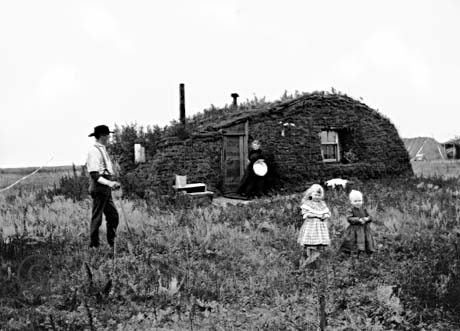
This is song about a farm on the frontier of 19th century America which is attacked by Indians.  It's from the perspective of a young teenage boy who's working on his family farm.

A typical sod home of 19th century homesteaders on the Great Plains.  (Source: http://savagesandscoundrels.org/events-landmarks/1841-western-emigration-society-formed/)

It's the kind of event that you won't see in any modern PC Westerns like Dances with Wolves, which portrays Indians in the typical Noble Savage myth, and Europeans as the brutes.  Nevertheless it's an event that may have been typical for families which bordered Indian Territory.  Events which included: Scalpings, kidnappings (of white women into slavery), and killings of innocent civilians.  Remember that tribal wars don't discriminate between 'soldiers' and 'civilians', like civilised warfare does (rather, used to, prior to Winston ‘The Adventurer’ Churchill scrapping 'Cruiser Rules' during WW1 thus allowing British warships to destroy unarmed and innocent merchant ships).  In tribal conflicts everyone is a viable target.  If the world moves more into the world of tribalism (the more violent, inhuman kind where Vikings performed the 'Odin’s Eagle' (haven't found a weblink for it, but it's in a book by historian Michael Wood), Cumans drank from human skulls, Timorians beheaded people etc) then this kind of event will start to happen again: tribes raiding each other for resources and women.


Play the song in the music video above and sing along in your head with the alternative lyrics below.


# The Wild Frontier #
On a farm in the mid-west America.
A sunny day ploughin' the fields.
When pa suddenly came a screamin'
"Look out it's the Indians!"

You're the frontier and they're comin' to scalp you.
On your own and there's no where to run to.
Here on Your farm you will stand and defy them.
Then saddle up and go get some payback.

Pa runs to the back of the barn store.
And grabs the muskets and ammo.
We don't know how we will fair now.
But we know we must kill them.

You're the frontier and they're comin' to scalp you.
On your own and there's no where to run to.
Here on Your farm you will stand and defy them.
Then saddle up and go get some payback.

They charge us and scream with their war cry.
And it scares the hell outta me.
'till I see the resolution in Pa's eyes,
as he fires off his musket.

You're the frontier and they're comin' to scalp you.
On your own and there's no where to run to.
Here on Your farm you will stand and defy them.
Then saddle up and go get some payback.

You're the frontier and they're comin' to scalp you.
On your own and there's no where to run to.
Here on Your farm you will stand and defy them.
Then saddle up and go get some payback.


[End of the Lyrics.]

Sunday, 24 November 2013

Havamal Snippets 104: Seeking Suttungr

Suttungr was/is/will be a Frost Giant.  A Frost Giant is a being that does not change, relative to a Fire Giant, which is a chaotic and unpredictable being.  Think of Frost Giants and Fire Giants in abstract terms that are present in every day situations.  For instance a Frost Giant would be a pile of block of ice, unchanging and stable; whereas a tumultuous torrent of a sea would a Fire Giant, because it is chaotic and upredictable.  These elements can be applied to everything, be it inorganic (eg chaotic tempestuous seas versus unchanging granite rocks), living beings,  or ideas (eg anarchism vs conservatism).


104
Inn aldna jötum ek sótta
nú em ek aptr um kominn
fátt gat ek þegjandi þar
mörgum orðum
mælta ek í minn frama
í Suttungs sölum           

I sought the old giant,
now I have come back again.
I got little from being silent there.
With many words
I spoke to my own advantage
in Suttungr's hall.

[End.]

Friday, 22 November 2013

Men of Yore: Meister Eckhart

This is another in a series of posts about men from history who have either achieved great things in one form or another by pushing boundaries: either in themselves or in society or science or exploration of some form.  Boundary pushing and growth is what men do, it's their nature: to grow and push outwards.  We, as men, are the frontiers men, the first to discover/uncover new territory, in a metaphysical sense (i.e. including both material and the immaterial) that is later colonised and 'civilised' by the rest of humanity.


Meister Eckhart


He expressed himself both in learned Latin for the clergy in his tractates, and more famously in the German vernacular in his sermons. His thoughts reach heights and depths that seem uniquely his. His manner of expression is at once simple yet abstract and bold enough to prompt him to be tried for heresy in his last years. He died before a verdict was reached, but considered himself a submissive child of the Church till the end. Contemporary Eckhart's status is uncertain: Dominican order has pressed in the last decade of the 20th century for his full rehabilitation and confirmation of his theologoical orthodoxy; pope John Paul II has voiced favorable opinion on this initiative, but the affair is still confined to the corridors of the Vatican bureaucracy.

Eckhart's central doctrines
Meister Eckhart is the most influential Christian Neoplatonist, (other notable Christian speculative mystics influenced by Neoplatonism include Blessed John of Ruysbroeck, Heinrich Suso, Johann Tauler and Angelus Silesius). Although technically a faithful Thomist (as a prominent member of the Dominican order), Eckhart had developed metaphysics and spiritual psychology of amazing boldness of expression, surprising richness of insight and enduring power of mythic imagery. Not surprisingly, major German philosophers, from Hegel to Heidegger have drunk from the wellspring of Eckhart's wisdom. Novel concepts Eckhart had introduced into Christian metaphysics clearly deviate from pedestrian scholastic canon: in Eckhart's vision, God is primarily fertile. Out of overabundance of love the fertile God gives birth to the Son, Logos Christ. Clearly (aside from a rather striking metaphor of "fertility"), this is rooted in Neoplatonic notion of "overflow" of the One that cannot hold back its abundance of Being. Just, as a Christian, Eckhart had imagined the creation not as a sort of almost "compulsory" overflowing (a metaphor based on a common hydrodynamic picture), but as the free act of will of Trinitary God. Another bold assertion is Eckhart's distinction between God and Godhead (Gottheit in German). True, these notions had been present in the Pseudo-Dionysius's writings and John Erigena's "De divisione naturae", but it was Eckhart who, with characteristic vigor and audacity, had reshaped the germinal metaphors into profound and disturbing images of polarity between the Unmanisfest and Manifest Absolute. Eckhart's psychology and pneumatology are even more original and seminal: he distinguished (as did early Gnostics like Valentinus) between psyche and spiritual element in human being. Valentinian "spiritual seed" is equivalent to Eckhart's "fuenklein", "scintilla animae" , ground of the soul or "soul-spark", which he identifies with "Imago Dei" from the Scripture. This indestructible and divine element in human being is for Eckhart (and for the major Christian mystical theology, including Eastern Othodox concept of "synteresis") only a potentiality, a latent function that needs to be nourished by vituous living and spiritual vigilance in order to grow and expand- unlike perfect Buddha nature from Mahayana Buddhism or Atman from Hindu Vedanta. The "Imago Dei" is sometimes compared to fallen Adam, exiled from Paradise, and the New Adam, or Christ Logos, is potentially the final destination of soul-spark if it, through classic Christian spiritual stages of purificative, contemplative and illuminative life comes to the unitive life where soul-spark is self-transformed into Christ Logos. Hence the great Eckhart's saying:" God gives every Good man everything He has given to His Son".

Eckhart is also spelled Eckard, Eccard. Meister means "the Master"

Source: http://www.biographybase.com/biography/Eckhart_Meister.html


Accused of heresy (because of his Neo-Platonic views) by the Catholic Church (that supposedly has Christ, who in my humble opinion is a Jewish Buddha, cf Cristian Lindtners research), Eckharts thoughts were kept under lock and key for several centuries.  This is unfortunate because it meant that the Catholic Church was neglecting a very important perspective that would have allowed it's parishoners to gain a greater understanding of God and their place in relation to him.  The Church decided to maintain its focus on more earthly and negative concerns (such as indulgences, focussing on Hellfire to keep the church goers in-line, etc). 

Here are Arthur Schopenhauers thoughts on Eckhart:
If we turn from the forms, produced by external circumstances, and go to the root of things, we shall find that Sakyamuni and Meister Eckhart teach the same thing; only that the former dared to express his ideas plainly and positively, whereas Eckhart is obliged to clothe them in the garment of the Christian myth, and to adapt his expressions thereto.[68]

Buddha, Eckhart and I all teach the same.[69]


[End.]


Wednesday, 20 November 2013

Havamal Snippets 103: Be cheerful with guests

It's best to hospitable to guests.  To neet their needs, the host needs to know a little about them: their likes and dislikes: be it the kind of food or drink, the music or entertainment, the conversation or whatever.  Hosting means having a well rounded set of knowledge, not specialised, but well rounded.

103
Heima glaðr gumi
ok við gesti reifr
sviðr skal um sik vera
minnigr ok málugr
ef hann vill margfróðr vera
opt skal góðs geta
fimbulfambi heitir
sá er fátt kann segja
þat er ósnotrs aðal              

At home a man [3] must be [1] glad
and cheerful with guests,
knowing about himself,
mindful and fluent,
if he wants to be well-informed;
he should often speak of good things.
He is called a monstrous fool,
the one who knows how to say almost nothing:
it is the character of the unwise.

[End.]

Monday, 18 November 2013

Alternative Lyrics to Well Known Songs 12 - Born Joyful

[Pre-amble: This is one in a series of posts which includes an alternative set of lyrics to a well known song.  Each post will also contain a short introduction to the topic at hand, and a brief explanation of the song itself.  A video of the original song will be included so that the reader can listen to the original song while reciting the alternative lyrics at the same time.]


The Song: Born Joyful (based on 'Born Slippy' by Underworld)
Life was intended to be a joyous thing, but somewhere along the line, we might occasionaly forget this.  We might be tempted by someone who offers us a fantasy, a pipe-dream, a 'pleasure filled life', the proverbial 'streets paved with gold'.  This is what drug pushers do.  It's what advertisers do.  It's what low grade philosophers and 'life coaches' do.  It's what the perverters of 'The American Dream' do.  All of them promise you over-whelming joy, but unlike Gods unconditional love, they promise it to you 'on a condition': so long as you go over to 'the other side of the valley'.  But this promise of greener pastures is just a nefarious ploy, a plan hatched by an evil schemer to suck you in and turn you into an unwitting slave to your own pleasures.  Once you've realised that the promise of 'a better life' was a lie, you're neck deep in the shit.  You've been sucked into a quagmire, you need to get out of it, and one way of doing that is with brute force: sheer bloody mindedness.  You need to smash the schemer, the drug-pusher, and force your way to freedom; back to the joyous world that your once knew.  Then you can live the life that you wanted: the joy-filled one.


Play the song, and if you can make sense of the lyrics (by the way, the original lyrics aren't coherent eitherLINK) then sing along in your head (or out loud if so inclined):

# Born Joyful #
Good day great day..
Top of the morning day.
It was a sunny day.
It was a fantastic day.
It was a beautiful day.
And smiles day.
And all going fabulous day.
You had,
Great son day.
Daughter day.
You had family day
And a great place to live.
And laughed all the day.
It was joy all over, all over.
All smiled at you day.

Good day great day.
Top of the morning day.
It was a sunny day.
It was a fantastic day.
It was a beautiful day.
And smiles day.
And all going fabulous day.
You had,
Great son day.
Daughter day.
You had family day
And a great place to live.
And laughed all the day.
It was joy all over, all over.
All smiled at you day.

You got tempted by a ploy.
By an evil scheme ploy.
Total nefarious wicked drug schemer.
Schemer wants your soul and all your laughter.
Trap you in his ploy.
His evil ploy,
His drug addict ploy dog.
Dirty sick addict ploy.
Make you sick ploy.
Big big time ploy.
Generation ploy.
To get your babes and babes and babes.
Make you 'member nothing ploy.
Make you his bitch ploy and get.
Dead like an slave.
Enslaved.

You get so sick of it.
You want to rebel right against it.
Hateful and angry.
Wrathful and hot inside.
On your mind-phone line.
And Wod and everything.
On your mind-phone.
And in walk an angel.

And you get up your Wod.
Fighting fists in a shit
hole at Tottenham Court Road
I just come out of the shit
Fighting with the most
Blood I ever had
Shouting.
Beserker, 'serker. 'serker, 'serker.
Shouting,
Beserker, 'serker. 'serker, 'serker.
Shouting
'serker. 'serker, 'serker.
Shouting,
'serker. 'serker, 'serker.
Shouting,
I'm a mega white thing.
Mega mega white thing.
Mega mega.
Shouting, beserker, 'serker. 'serker, 'serker.
I'm a mega white thing.
Mega mega white thing.
Nefarious schemer is now dead.
He in shit hole now.
Blood going back to Odin.
Mega mega mega going back to freedom.
Hi day are you having fun.
And now I can go on my way.
To a new freedom.
Freedom..

[End of Lyrics]

Sunday, 17 November 2013

Havamal Snippets 102: Many a good maid is fickle-minded towards men

Women being fickled-minded towards men at least 1000 years ago?  Well you know what they say: some things never change!


102
Mörg er góð mær
ef görva kannar
hugbrigð við hali
þá ek þat reynda
er it ráðspaka
teygða ek á flærðir fljóð
háðungar hverrar
leitaði mér it horska man
ok hafða ek þess vættki vífs              

Many a good maid,
if you look closely,
is fickle-minded towards men;
I learned that
when [6] I tried to seduce
the [5] wise [6] woman to wantonness,
[8] the clever maid heaped *
[7] her scorn [8] on me,
and I got nothing from this woman.

[End.]

Friday, 15 November 2013

Men of Yore: John Cowperthwaite

This is another in a series of posts about men from history who have either achieved great things in one form or another by pushing boundaries: either in themselves or in society or science or exploration of some form.  Boundary pushing and growth is what men do, it's their nature: to grow and push outwards.  We, as men, are the frontiers men, the first to discover/uncover new territory, in a metaphysical sense (i.e. including both material and the immaterial) that is later colonised and 'civilised' by the rest of humanity.


John Cowperthwaite

John James Cowperthwaite was born on April 25 1915 and educated at Merchiston Castle School in Edinburgh. He went on to study Economics at St Andrews University and Christ's College, Cambridge, before joining the Colonial Administrative service in Hong Kong in 1941. During the Japanese occupation he was seconded to Sierra Leone.

Returning to Hong Kong in 1945, he was asked to find ways in which the government could boost post-war economic revival; but he found the economy recovering swiftly without intervention, and took the lesson to heart.
[..]
Cowperthwaite was a classical free-trader in the tradition which stretched from Adam Smith to John Stuart Mill and Gladstone, rather than a modern monetarist. He was also a seasoned colonial administrator, with a strong streak of common sense. But his achievement in Hong Kong was hailed by Milton Friedman and other free-market economists as a shining example of the potency of laissez-faire when carried through to its logical conclusions in almost every aspect of government. The Right-wing American commentator PJ O'Rourke called Cowperthwaite "a master of simplicities".

Cowperthwaite himself called his approach "positive non-intervention". Personal taxes were kept at a maximum of 15 per cent; government borrowing was wholly unacceptable; there were no tariffs or subsidies. Red tape was so reduced that a new company could be registered with a one-page form.

Cowperthwaite believed that government should concern itself with only minimal intervention on behalf of the most needy, and should not interfere in business. In his first budget speech he said: "In the long run, the aggregate of decisions of individual businessmen, exercising individual judgment in a free economy, even if often mistaken, is less likely to do harm than the centralised decisions of a government, and certainly the harm is likely to be counteracted faster."
[..]
Cowperthwaite summed up his part in the colony's success over the decade with some modesty: "I did very little. All I did was to try to prevent some of the things that might undo it."
The measure of that success was a 50 per cent rise in real wages, and a two-thirds fall in the number of households in acute poverty. Exports rose by 14 per cent a year, as Hong Kong evolved from a trading post to a major regional hub and manufacturing base.
[..]
Cowperthwaite himself had a Gladstonian sense of obligation towards the least fortunate: he rejected the notion of tax relief on mortgage interest because it would have benefited the better-off and might have prejudiced "our maximum housing effort at the lower end of the scale".


This is one man who had a significant role in the growth of Hong Kong from a small trading post to a prosperous manufacturing city.  He gave the population freedom from excessive government interference and allowed them to get on with their lives, meaning that the government was really in a subsidiary role, a supporting role rather than the leader of the city-state.


[End.]